
What Should Foreign Brands Get Right Before Investing in SEO in China?

For foreign brands, launching a simplified Chinese website can feel like the natural first step towards building search visibility in China. But translated content alone does not make a website accessible, discoverable or commercially useful.
SEO in China for foreign brands sits within a different technical, linguistic and commercial environment. Search demand may use unfamiliar category language. Baidu may not reach or index priority pages as expected. Users may need different proof before they trust the brand, while incomplete tracking can make traffic look more valuable than it is.
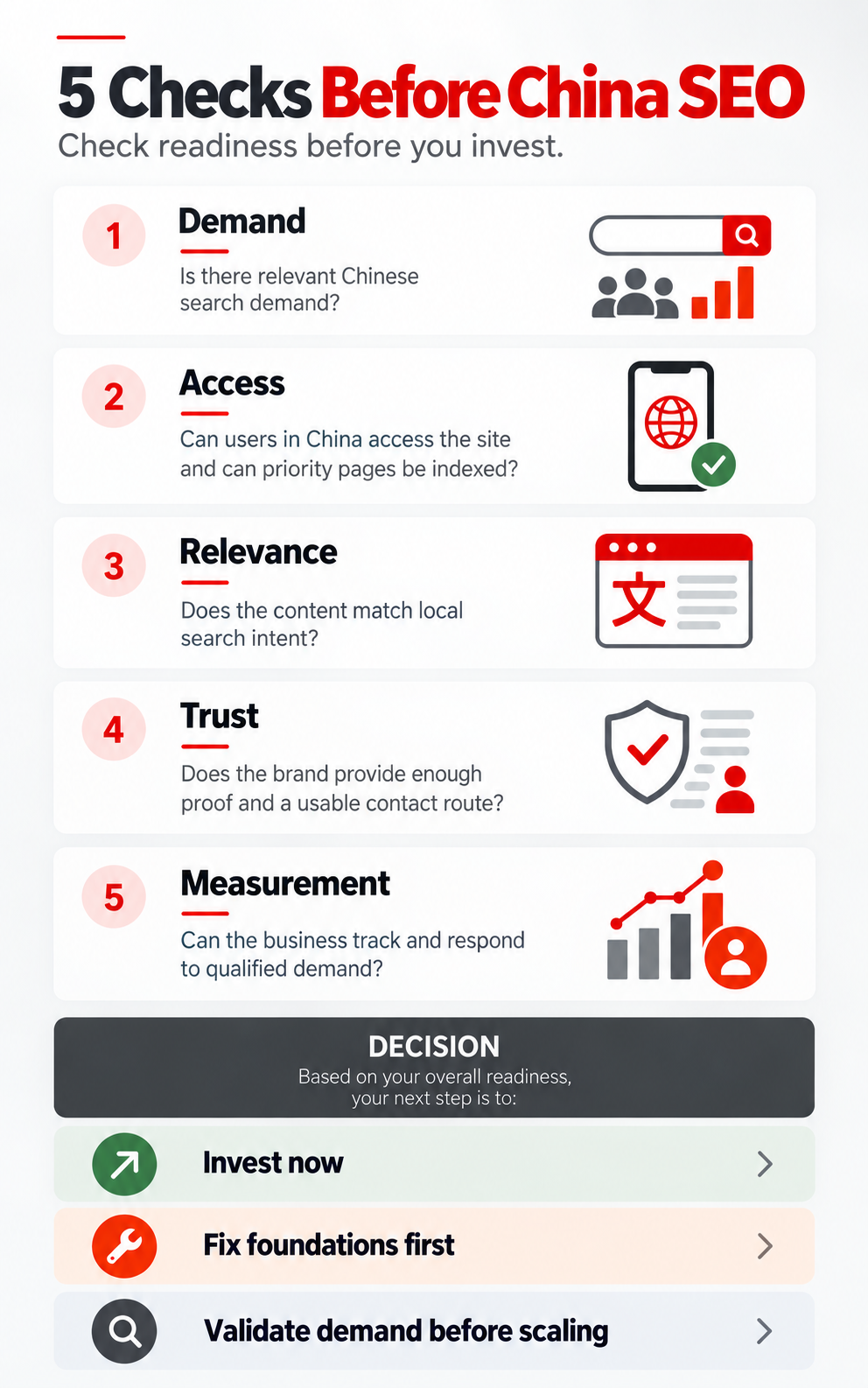
Before investing at scale, brands should assess five areas:
Demand → Access → Relevance → Trust → Measurement
Together, these form the Comms8 China SEO Readiness Check. The framework helps businesses decide whether they are ready to invest, need to fix essential foundations or should validate demand before expanding the programme.
1. Demand: Is There Enough Relevant Search Demand to Justify the Investment?
A brand’s performance on Google does not automatically prove that the same search opportunity exists in China.
Before committing to technical work or Chinese-language content production, the business needs to establish who is searching, what language they use and whether those searches connect to a realistic commercial opportunity.
This requires more than translating a global keyword list. Research should distinguish between branded and non-branded demand, informational and commercial intent, and international category terminology versus the language Chinese users actually use.
The commercial context matters too. A search term may attract interest without representing a realistic customer opportunity. Brands therefore need to consider whether the product or service is available in China, whether the proposition is relevant and what action a user can take after arriving on the website.
Baidu Index can support this assessment by showing keyword trends, related demand, audience interests and audience characteristics. These signals are useful for identifying patterns, but they should be treated as directional evidence rather than a forecast of revenue or SEO performance.
Search data should also be considered alongside competitor visibility, current enquiries, distributor feedback and wider market-entry priorities. Together, these inputs help clarify whether organic search should support category education, brand validation, lead generation or another stage of the customer journey.
Where demand remains uncertain, a focused Baidu SEM or landing-page test may provide additional evidence before the brand commits to a larger organic programme. Paid-search performance cannot predict SEO results, but it may reveal whether the intended audience responds to the terminology, proposition and conversion path.
At Comms8, we see demand validation as a market-entry decision rather than a keyword-volume exercise. The objective is not simply to find phrases with search activity. It is to identify search demand that the brand can serve credibly and convert effectively.
A brand is better prepared to invest when it can answer four questions:
Who is the intended Chinese audience?
What need is driving the search?
Which search themes are commercially relevant?
What useful next action can the website offer?
If these answers remain unclear, the immediate priority should be validation rather than scale.
2. Access: Can Baidu and Chinese Users Reach the Website Reliably?
Search demand has limited commercial value if users cannot access the website reliably or Baidu cannot reach and index its priority pages.
Hosting is one part of this assessment, but it should not be treated as a shortcut to visibility. No single hosting arrangement guarantees stronger rankings. The appropriate setup depends on the organisation’s infrastructure, audience, compliance requirements and operational capacity.
For mainland-China hosting, confirm the applicable ICP filing or licensing requirements with the hosting provider before launch. Wherever the website is hosted, test access from China and check priority-page crawl and index status in Baidu’s Search Resource Platform.
These checks should extend beyond the homepage. The pages most important to the customer journey need to load reliably and provide a usable experience on mobile devices. Essential content, navigation, enquiry forms and contact routes should function for the intended audience.
Brands should also review whether important information depends on scripts, embedded services or external assets that do not perform reliably for users in China. A page may technically load while still delivering an incomplete or frustrating experience.
Baidu SEO readiness therefore requires two related checks:
User access: Can the intended audience reach, understand and use the important pages?
Search access: Can Baidu discover, crawl and index those pages?
Passing one test does not guarantee the other. A page may be accessible to users but absent from the index, or indexed while providing a poor mobile experience.
The objective is not to prescribe one infrastructure model. It is to identify barriers before the brand invests in a wider content programme. If priority pages cannot be reached, indexed or used reliably, technical access should be addressed before the business scales production or promotion.
3. Relevance: Does the Content Match Chinese Search Intent?
A Chinese-language website can be linguistically accurate and still fail to answer the questions Chinese users are asking.
Direct translation usually preserves the structure and priorities of the original website. It does not automatically account for local terminology, category knowledge, buying concerns or the evidence users need before taking action.
Content planning should therefore begin with Chinese search intent rather than the English source copy.
Each priority page should have a defined role. It may need to explain a product, answer a common question, establish the brand’s credibility or help a user move towards an enquiry. The language, structure and proof points should support that role.
Baidu publishes official content-quality guidance and page-quality guidance for site owners.
For an international brand, localisation may need to include:
Chinese category terminology
Locally relevant questions and objections
Clear product or service information
Appropriate proof points
Chinese-language FAQs
Platform-appropriate calls to action
A content hierarchy based on local demand
The Chinese website should not automatically reproduce every page on the global site. A page should be created or prioritised because it supports identifiable search demand and provides information that helps the audience make a decision.
Titles, headings and body content also need to remain consistent. A page that attracts a click through one promise but delivers unrelated or incomplete information may gain visibility without building confidence.
Content relevance should be assessed across the wider customer journey. An informational page may help users understand a category. A service page may need to demonstrate capability and clarify the next step. Branded content may need to reinforce the company’s legitimacy when users investigate it.
At Comms8, we treat translation as one part of production—not the strategy itself. Localisation begins with understanding what users need to know, how they express that need and what will make the answer credible in-market.
The brand is better prepared when its priority pages are mapped to researched Chinese search themes and provide locally relevant information, evidence and next steps. If the site simply mirrors its English structure, content expansion should wait until the Chinese search journey has been defined.
4. Trust: Does the Brand Look Credible When Users Investigate It?
Visibility can introduce a foreign brand to potential customers, but it does not automatically create confidence.
Users need to understand who the company is, what it offers and whether it can support them. If business details are inconsistent, product information is difficult to understand or the next step is unclear, stronger rankings may increase visits without producing useful demand.
The trust signals required will depend on the category and buying decision. A consumer making a relatively simple purchase may focus on product information, availability and reassurance from other users. A business buyer may need technical documentation, compatibility information, sector experience and clarity about local service or delivery.
Priority pages should therefore provide the evidence appropriate to the decision. This may include:
Consistent company and contact information
Understandable Chinese-language product or service details
Relevant certifications, credentials or approved proof points
Clear information about availability, delivery or local support
Answers to common commercial and technical questions
A contact route that users can access and the business can manage
Trust also depends on what happens after the enquiry. A Chinese-language form is of limited value if the business cannot route, understand or respond to the submission. The conversion journey needs an owner, a workable response process and realistic expectations about the markets the company can serve.
Illustrative example
Consider an international B2B supplier with relevant demand in China but limited local brand awareness. Rather than publishing a generic translation of its global product page, the company creates a Chinese-language page that answers compatibility questions, explains the available support model and provides a clear enquiry route.
This does not guarantee rankings or leads. It does, however, give interested buyers more of the information they need to evaluate the supplier and take the next step.
The example illustrates a planning principle rather than a client result: trust is created by reducing uncertainty around the specific decision the audience needs to make.
A brand is better prepared to invest when its search pages do more than mention the right keywords. They should also explain the proposition, provide relevant evidence and make it easy for a qualified user to continue the conversation.
5. Measurement: Can Search Visibility Be Connected to Qualified Demand?
Rankings and traffic may indicate progress, but they do not show whether China SEO is generating commercially useful demand.
Measurement should begin before new content is published. The business needs a baseline for its priority pages, agreed conversion actions and a process for evaluating enquiry quality.
The Baidu Search Resource Platform provides tools covering index volume, traffic and keywords, crawl frequency, crawl diagnostics and crawl errors. These tools can help teams understand whether priority pages are being discovered, indexed and shown for relevant searches.
A practical China SEO measurement model should connect four levels.
Technical visibility
The first question is whether Baidu can discover and index the pages that matter. Reporting may include crawl status, index volume and the inclusion of priority sections.
Indexation is a prerequisite for visibility, but it is not a performance outcome by itself.
Search performance
The next level examines relevant queries, impressions, clicks and landing-page visibility.
This analysis should focus on search themes that matter to the business rather than reporting every keyword equally. Brand queries, category research and high-intent searches may perform different roles and should be interpreted accordingly.
User response
Traffic needs to be evaluated against what users do after reaching the site.
Depending on the website, useful actions may include reading a priority page, visiting a product or service section, downloading information, submitting a form, booking a consultation or contacting the business.
Commercial quality
The final level assesses whether the resulting enquiries or registrations match the intended customer profile.
Sales and customer-service feedback can help determine whether organic search is attracting relevant prospects or generating traffic with limited commercial value.
These four levels should not be collapsed into one headline number. A page can be indexed without attracting meaningful searches. It can receive clicks without answering the user’s question. It can also generate enquiries that are unsuitable for the business.
Reporting should therefore help the team answer:
Which search themes are producing relevant visibility?
Which pages are attracting the intended audience?
Where are users leaving the journey?
Which calls to action are being used?
Which enquiries are commercially relevant?
What should be changed next?
Measurement also depends on operational readiness. Analytics need to work on the priority pages, conversion actions must be configured correctly and Chinese-language enquiries need a clear follow-up route.
If CRM integration is unavailable, a consistent manual source field or enquiry tag may be needed. If tracking is incomplete, the gap should be reported as unavailable data—not interpreted as zero commercial performance.
At Comms8, we believe reporting should guide the next decision rather than produce a larger dashboard. The objective is to understand whether search visibility is becoming useful demand and which technical, content or conversion issue should be addressed next.
6. Decide Whether to Invest, Fix the Foundations or Validate Demand
The five readiness areas should lead to a practical decision. Not every brand needs to begin with a full China SEO programme.
Invest
The brand may be ready to invest when it has evidence of relevant search demand, reliable access to priority pages, locally relevant content, appropriate trust signals and a way to measure and respond to qualified enquiries.
Investment can then focus on building sustainable visibility across the search themes and customer journeys that matter commercially.
Fix the foundations
The opportunity may be credible while the website is not yet ready to support it.
Priority work may include improving China-side access, resolving crawl or index problems, restructuring Chinese-language content, strengthening proof or repairing the enquiry and measurement journey.
Addressing these issues first can prevent the business from spending more on content that users cannot find, trust or act upon.
Validate demand
If the audience, terminology or commercial role of search remains uncertain, the business may need more evidence before scaling.
Focused keyword research, competitor analysis, customer interviews, a limited landing-page programme or carefully designed paid-search testing can help clarify whether the opportunity deserves further investment.
Validation is not a weaker version of strategy. It is a way to reduce uncertainty before committing more budget.
The right decision may also differ by product line or audience. A brand can be ready to invest in one high-priority area while continuing to validate another. The readiness framework should therefore guide sequencing as well as the overall go/no-go decision.
Build China SEO on Market Readiness, Not Translation Alone
A Chinese-language website is only one component of search readiness.
Foreign brands also need evidence of commercially relevant demand, reliable access for users and Baidu, content shaped around Chinese search intent, credible information and a measurement process connected to enquiry quality.
The Demand → Access → Relevance → Trust → Measurement framework helps teams identify what is ready, what needs attention and what still requires validation.
For brands that need support with technical assessment, Baidu visibility and Chinese-language content planning, explore Comms8’s SEO services in China.