
Thailand Creator Commerce: A Market-Entry Guide for Global Brands

Thailand’s creator-commerce opportunity is easy to misread.
An international brand may see livestreams, affiliate links, social video and marketplace promotions, then conclude that the next step is to recruit more influencers. That approach focuses on visible content while overlooking the commercial system behind it.
According to the 2025 Thailand e-Conomy SEA report, Thailand’s ecommerce GMV reached an estimated US$33 billion, within an overall digital economy valued at US$56 billion. These figures do not measure creator commerce directly, but they demonstrate the scale of the environment in which creators, platforms and marketplaces can influence purchase decisions.
For this article, “KOS-style seller-creator” is used as planning shorthand for a creator whose role includes explaining products, interacting with customers and supporting conversion. It is not presented as a formally established creator category across Thailand.
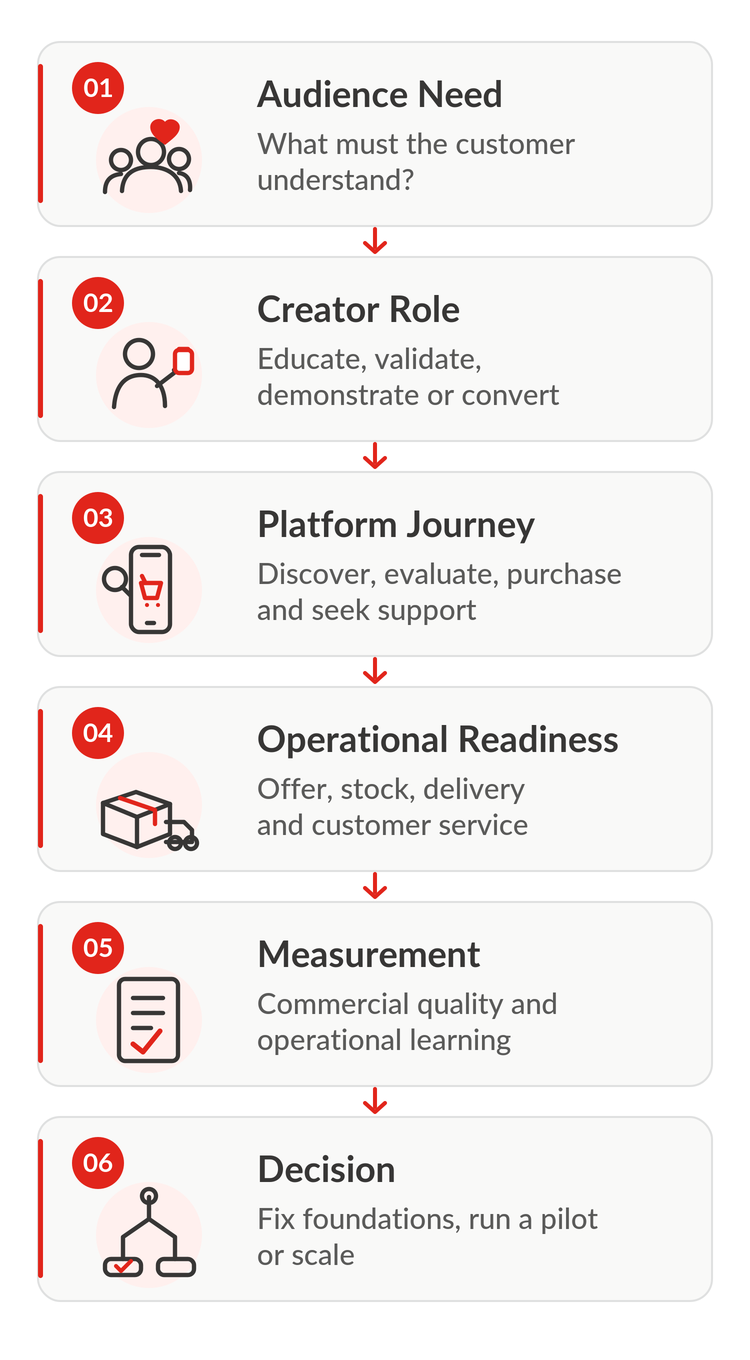
At Comms8, we see this opportunity less as a new creator label and more as a market-entry system. Its success depends on how well a brand connects cultural relevance, platform behaviour, product education, promotional mechanics, fulfilment and measurement.
The strategic question is not whether Thailand is reproducing another market’s model. It is how global brands should design creator commerce for Thailand’s own commercial and cultural environment.
1. Thailand’s Creator-Commerce Opportunity Is Not a Copy of China
China offers useful lessons about the integration of content, livestreaming, ecommerce and creator-led selling. However, importing the same terminology, creator structure and conversion journey into Thailand would overlook important market differences.
Consumer expectations, language, promotional behaviour, platform functions and service infrastructure vary by market. A selling format that works on one platform may feel inappropriate on another. A creator who performs well as an entertainer may not have the product authority required to answer detailed customer questions. A promotion capable of attracting a large audience may still fail if stock, delivery or customer support cannot meet demand.
Global brands should therefore separate the transferable principle from the local execution.
The transferable principle is that creators can do more than generate reach. They can make products easier to understand, provide reassurance and reduce the distance between discovery and purchase.
The execution must be designed for Thailand.
Planning a culturally informed market entry should begin by establishing what Thai customers need to know, where they evaluate products and what could prevent them from completing or repeating a purchase. Creator selection comes after those questions—not before them.
2. What KOS-Style Seller-Creators Add to the Journey
Traditional influencer briefs often focus on content production and audience exposure. The creator is asked to introduce a product, follow key messages and generate views or engagement.
A KOS-style seller-creator has a more commercially specific role. Depending on the category and campaign, that role may include:
Demonstrating how a product works
Explaining differences between products or variants
Answering audience questions
Addressing concerns about quality, suitability or use
Communicating an offer or promotional mechanic
Directing audiences towards a marketplace, retailer or enquiry route
This does not mean every creator should become a salesperson.
Some creators are effective because they entertain. Others provide specialist knowledge, visual inspiration or community credibility. Livestream hosts may be strong at maintaining energy and responding quickly, while category experts may be better suited to high-consideration products.
The brief should define what each creator is expected to contribute. Awareness, education, validation and conversion are different jobs and may require different partners.
Brands should therefore assess creators against the intended commercial role. Relevant questions include whether they understand the category, communicate clearly, maintain audience trust and can work within the operational requirements of the campaign.
3. Local Trust Determines Whether Selling Feels Credible
Seller-led content depends on the audience accepting the creator as a useful source of information rather than a temporary advertising channel.
Research into trust and purchase intention in Thai social livestream commerce, based on 480 people who had purchased through Thai influencer livestreams, found that trust, engagement, perceived value and social presence had a direct and significant relationship with purchase intention.
The study used non-probability sampling, so it should not be treated as representative of every Thai consumer. It nevertheless provides useful evidence that the interaction surrounding a livestream can matter alongside the offer itself.
This has practical implications for creator strategy.
Creators need enough product knowledge to answer genuine questions. The language and examples should feel natural to the intended audience. Demonstrations should help people evaluate the product rather than simply repeat brand claims. Questions that cannot be answered immediately should have a clear route to customer support.
That is why localising content for the intended audience involves more than translating captions or campaign scripts. It should shape the product explanation, tone, proof points, visual presentation and response to common customer concerns.
Over-scripting can remove the conversational quality that made the creator credible. Under-briefing creates a different risk: unclear claims, inconsistent product information or promises that the wider operation cannot support.
The brand should control accuracy and boundaries while allowing the creator to communicate with the familiarity their audience expects.
4. The Platform and Marketplace Journey Shapes Conversion
Creator commerce rarely follows a single-channel path.
A customer may first encounter a product through short-form video, watch a longer demonstration, check comments, search for further information and complete the purchase through a marketplace. Questions about delivery, product use or returns may then move into direct messages or customer-service channels.
Totem’s 2025 Thailand commercial survey of 546 consumers and 21 brand and marketing managers provides a directional view of this journey. It found different roles across platforms, with TikTok and Facebook contributing to discovery and consideration while Lazada and Shopee were more closely connected to conversion and post-purchase activity.
The sample should not be treated as a complete representation of Thailand, but it shows why platform roles need to be planned rather than assumed.
For brands, the first question should not be, “Which platform is best?”
The more useful questions are:
Where will the customer first encounter the product?
Where can they obtain enough information to evaluate it?
Where will the transaction happen?
What happens if they have a question before or after buying?
Which parts of the journey can be tracked reliably?
A creator may initiate demand without owning the transaction. Marketplace content may close a sale without being the original source of discovery. Paid media may extend effective creator content to a larger audience. Community and service channels may determine whether a first-time customer becomes a repeat customer.
Connecting social activity with community-led growth requires each creator, platform and service touchpoint to have a defined purpose.
5. Creator Commerce Needs an Operating System Behind It
Creator content can accelerate demand. It cannot solve an unavailable product, a confusing offer or a poor delivery experience.
Before activation, brands should confirm:
Local product availability and inventory
Pricing and promotional rules
Creator fees, commissions and attribution
Voucher terms and campaign dates
Marketplace and checkout readiness
Delivery coverage and timelines
Returns and refund procedures
Customer-service responsibilities
Content approval and escalation processes
Advertising disclosure and category-specific requirements
These decisions affect the creator brief. A host needs to know whether stock is limited, which product variations are available and how customers can obtain support. Customer-service teams need advance notice of likely questions. Media teams need to know whether the offer can support additional demand.
Compliance also needs to be incorporated before content is produced. In September 2026, Thailand’s Office of the Consumer Protection Board and advertising-sector partners announced influencer-advertising guidance covering reviews, livestreams, product links and AI-generated content. The guidance is intended to improve disclosure and help consumers distinguish sponsored material from independent content.
Brands should confirm the requirements that apply to their category and campaign with qualified local advisers. This article provides operational guidance, not legal advice.
Creator commerce becomes commercially useful when the promise made in the content matches the experience delivered after the customer acts.
6. Pilot the Commercial Model Before Scaling It
A pilot should test the complete journey, not simply whether a creator can generate views.
Start with a product that has a clear reason to demonstrate. Define the audience and the question the creator needs to answer. Assign each partner a role, then connect the content to a purchase or enquiry route that is ready to handle demand.
A useful pilot should specify:
The product, audience and commercial objective
The function of each creator
Short-form, livestream or supporting content requirements
The offer and promotional mechanics
Paid amplification, if required
Inventory, delivery and service responsibilities
Tracking and reporting requirements
Criteria for continuing, changing or stopping the activity
Brands should also test the internal workflow. How quickly can product questions be answered? Who approves changes during a live activation? What happens if an offer ends early or a product becomes unavailable? Who responds when a customer experiences a problem?
These may appear to be operational details. In creator commerce, they are part of the customer experience and can directly affect trust.
The objective of the pilot is not to prove that creator commerce works in general. It is to identify which combination of creator role, content format, platform, offer and operating support works for the brand in Thailand.
7. Measure Commercial Quality, Not Sales Volume Alone
Sales matter, but a single sales total does not explain why the campaign performed or whether the result can be repeated.
Measurement should reflect the role assigned to each creator and touchpoint:
Discovery: relevant reach, video views, watch time and audience geography
Consideration: product-page visits, audience questions, saves and meaningful engagement
Commerce: product clicks, add-to-cart activity, completed purchases and acquisition cost
Customer quality: cancellations, returns, enquiry quality and customer-service feedback
Retention: repeat engagement or purchase where suitable tracking is available
Operational metrics are also useful. Brands may need to review response times, stock availability, fulfilment issues and recurring customer questions. These signals can reveal why a commercially promising activation is creating friction.
Platform-attributed sales should not automatically be treated as fully incremental revenue. Attribution windows, repeat customers, overlapping media and untracked journeys can all affect the reported result.
An integrated media, search and performance plan should connect creator reporting with marketplace, media and customer outcomes. The purpose is to understand what should be repeated, what needs improvement and whether the model is commercially sustainable.
8. How Comms8 Connects Market Entry with Local Execution
Creator commerce sits across market strategy, culture, content, media, ecommerce and operations. Treating these as separate workstreams increases the risk that a strong creator idea reaches the market without a credible path to conversion.
Comms8 helps international brands connect:
Market and audience research
Cultural positioning and content localisation
Platform and customer-journey planning
Creator-role definition and campaign activation
Paid-media planning and amplification
Creator campaign planning, reporting and optimisation
Our role is to help brands determine what creators should achieve, which platforms and commercial touchpoints should support them, and what operational foundations need to be ready before activation.
This includes identifying where a global strategy should remain consistent and where the message, format, offer or customer journey needs to change for Thailand.
The objective is not to reproduce a Chinese KOS model in Thailand or attach sales targets to every influencer. It is to build a locally relevant creator-commerce system in which the right people, platforms and commercial processes work together.
Brands that are not operationally ready should strengthen their foundations first. Brands with a credible opportunity but limited market evidence should run a controlled pilot. Brands with repeatable results can then scale with greater confidence.
Planning creator commerce in Thailand? Brief Comms8 on your market-entry, localisation and local-execution plans.