
An American Launch Needs a Position, Not Just a Bigger Media Budget
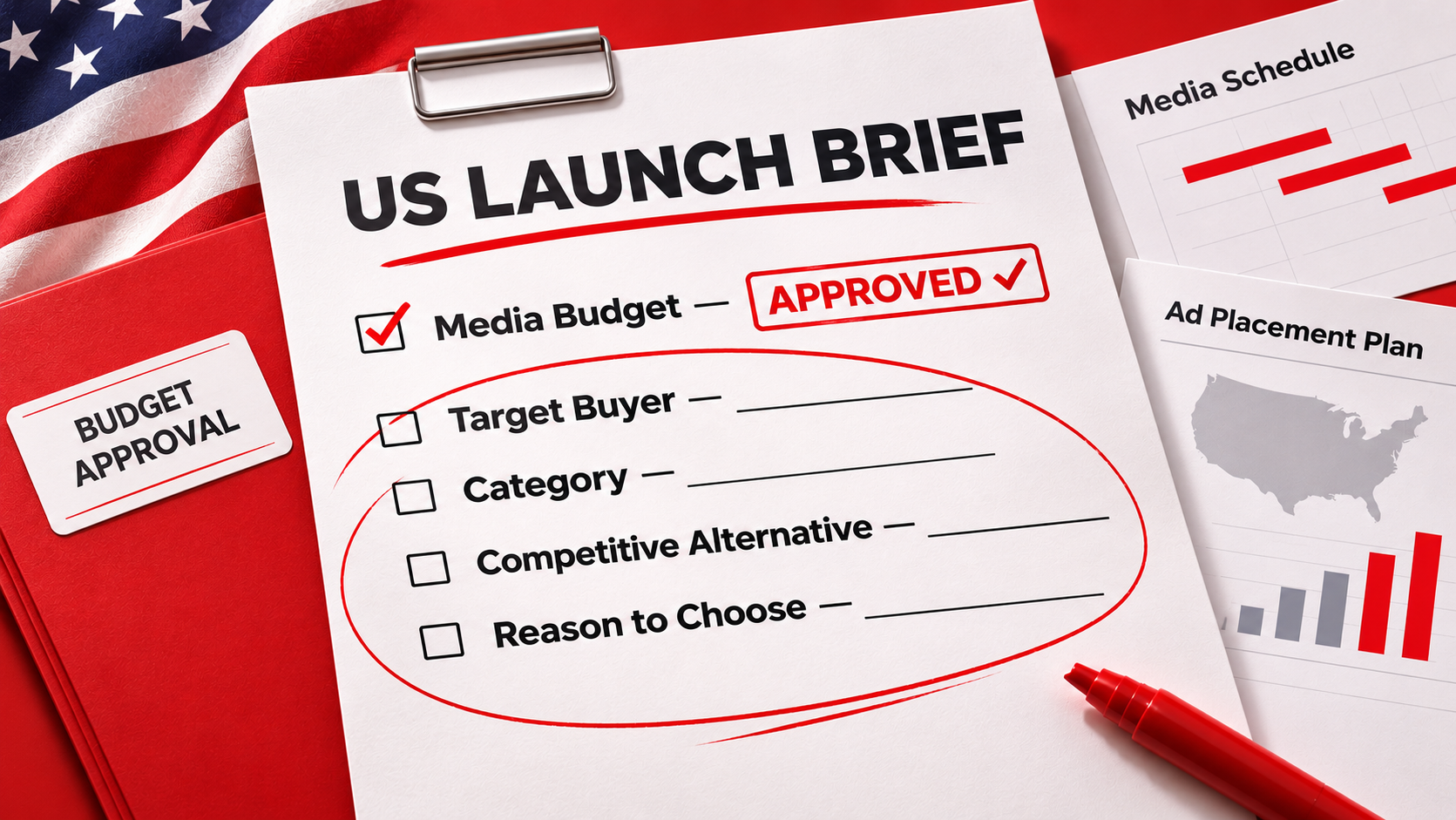
A larger media budget can make a brand more visible. It cannot decide what a US buyer should compare that brand with, why the offer matters or what makes it credible.
For an Asian brand entering the United States, this distinction is commercially important. A proposition that is already successful at home may provide a strong foundation, but it does not automatically establish a clear position in a different category, competitive set or buying environment.
In this article, “Asian brands” refers broadly to brands headquartered in Asian markets and planning US expansion. It does not suggest that those brands share one identity, market background or commercial challenge.
Before discussing reach, teams need to answer six connected questions:
Buyer → Category → Alternatives → Reason to Choose → Local Decision → Media Readiness
These questions form the Comms8 US Launch Positioning Check. They help a launch team determine whether the business is ready to scale awareness or whether the proposition still needs market validation.
1. Start With a Named Buyer
“The US consumer” is not a useful target audience.
The United States contains different regions, industries, household profiles, business environments and buying situations. A brand cannot build a credible market position around a customer described only by country, age or income.
A useful audience definition should identify:
Who is experiencing the problem
What situation causes that problem to become important
Who evaluates or approves the available options
What constraints shape the decision
What would make the customer change their current behaviour
For a consumer brand, this may mean defining a specific household, lifestyle, need state or purchase occasion. For a B2B offer, it may involve several people: the operational user, technical evaluator, budget owner and executive sponsor.
The distinction matters because each person may need different information. A user may care about ease and functionality. A financial decision-maker may need evidence of efficiency. A procurement team may focus on risk, terms and implementation requirements.
The US Small Business Administration’s guidance on market research and competitive analysis recommends combining customer research with an assessment of the competitive environment. The US Census Bureau also provides tools such as Census Business Builder, which gives access to demographic and economic information that can support early market assessment. These resources can help establish the shape of an opportunity, but brand-specific research is still needed to understand motivations, objections and buying behaviour.
A named buyer should be specific enough to research and reach. If the launch team cannot identify who should care about the offer and under what circumstances, channel planning is premature.
2. Define the Category the Buyer Will Use
Brands tend to describe themselves using the category language they already know.
That language may come from the home market, the product-development team or an internal view of the company. A US buyer may use different terms, group the problem differently or place the offer in another competitive frame.
Category definition affects more than SEO. It determines:
Which competitors appear relevant
What buyers expect the product to include
Which claims require explanation
What price range feels reasonable
A category that is well understood at home may require reframing in the United States. Conversely, inventing a new category too quickly can create unnecessary education costs if buyers already have established language for the problem.
Teams should investigate:
The phrases buyers use when describing the problem
The terms used in search queries and industry discussions
How retailers, marketplaces or distributors organise similar products
How competitors describe their offers
Which category labels buyers recognise without explanation
Whether the product crosses more than one established category
Whether regulation or professional standards affect the terminology
The objective is not to copy competitor language. It is to understand the decision context the brand is entering.
A brand may prefer to describe its product as an entirely new solution. The buyer may initially compare it with a familiar service, an internal process or a lower-cost substitute. Positioning needs to begin with that real comparison, even if the brand intends to change the category over time.
3. Map the Full Set of Alternatives
A competitor list is rarely enough.
The buyer’s alternatives may include established brands, specialist providers, lower-cost products, internal workarounds and the option of doing nothing. Each can create a different barrier to entry.
The SBA advises businesses to examine direct and indirect competitors, barriers to entry and the importance of the target segment to existing providers. This is useful because the strongest commercial obstacle may not be another brand selling an identical product. It may be a familiar process that feels easier or less risky to the customer.
A practical alternatives map should consider four groups.
Direct competitors
These are brands offering a similar solution to the same customer. The launch team should understand their positioning, pricing structure, distribution, proof points and perceived strengths.
Indirect competitors
These offers solve the same underlying problem in a different way. They may compete for the same budget without appearing in a conventional competitor list.
Internal substitutes
In B2B categories, a company may continue using spreadsheets, manual processes or an internal team. In consumer categories, a customer may improvise with products already available at home.
Doing nothing
The status quo is often the most underestimated alternative. A buyer may recognise a problem but decide that changing supplier, learning a new product or accepting implementation risk is not worthwhile.
This analysis reveals what the brand actually needs to overcome. If the primary barrier is familiarity, the message may need to reduce perceived risk. If the market is crowded with similar claims, the brand may need sharper evidence. If the status quo appears adequate, the case for change must be stronger than a list of product features.
The output should be a defensible view of where the brand can stand apart, not a claim that it is completely unique.
4. Build a Reason to Choose That the Brand Can Prove
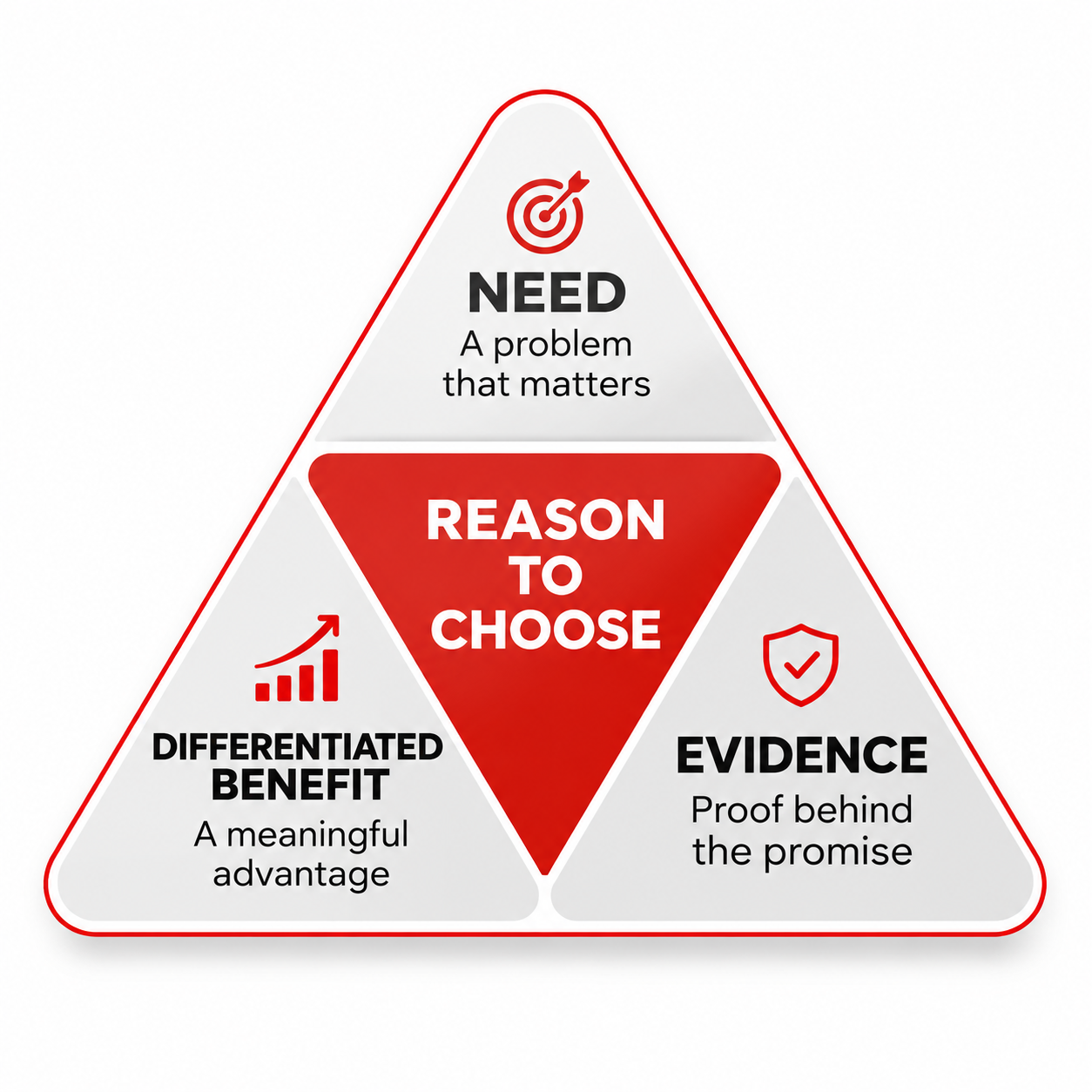
A position becomes commercially useful when it connects three elements:
A need that matters to the named buyer
A benefit that is meaningfully differentiated
Evidence that supports the promise
Removing any one of these weakens the position.
A relevant need without differentiation gives the buyer little reason to change. A distinctive feature without customer relevance becomes product information rather than a reason to choose. A persuasive promise without evidence creates a credibility gap.
The strongest evidence will depend on the category and decision. It may include:
Product performance
Customer outcomes
Independent certifications
Technical compatibility
Retail or distribution availability
Service and support arrangements
Demonstrations or trials
Customer reviews
Relevant partnerships
Approved case studies
Claims should be assessed for both relevance and substantiation. A proof point that impressed customers in the home market may not carry the same authority in the United States. An award may need context. A market-leading position at home may demonstrate capability, but it does not prove that the product is already preferred by US customers.
Asian origin can form part of the story when it contributes something meaningful: specialist expertise, design heritage, manufacturing capability, category innovation or a culturally distinctive experience. It should not be treated as automatic differentiation, reduced to decorative imagery or used to make an unsupported claim about quality.
The question is not whether the brand should hide where it comes from. It is whether its origin helps explain a benefit the US buyer values and the business can prove.
Illustrative example, not a client case:
A Japanese homeware brand might initially lead with “premium Japanese design”. For US buyers furnishing small flats, a more specific positioning hypothesis could be “compact storage that makes limited space easier to use”. That promise would need evidence such as verified dimensions and practical demonstrations, then testing with the intended buyers before scaling media.
5. Localise the Decision, Not Only the Language
US localisation should begin with the buying decision rather than the final copy.
The English used in a home-market campaign may be grammatically correct and still feel unfamiliar, overly formal or disconnected from the way US buyers describe the problem. Literal translation can create the same issue, but language is only one part of the work.
Teams should review:
The terminology used for the category
The order in which benefits are presented
The objections that must be resolved
The proof buyers expect
The preferred route to purchase or enquiry
Expectations around fulfilment, returns and support
Comms8’s guidance on marketing asset localisation explains why meaning, proof, format and customer journey all need to be assessed when a campaign moves between markets. A message can remain understandable while losing commercial relevance.
The same principle applies to a US launch. A campaign should not simply exchange an Asian context for generic American imagery. It should address the actual questions that influence the buyer.
For illustration, a B2B technology brand may find that its product capability is clear while prospects still need stronger information about integration, data handling, implementation and local support. A consumer brand may need to clarify availability, sizing, delivery or returns before its brand story can convert interest into action.
The specific barriers should be validated with the intended US customer. Effective market entry and cultural strategy connects this local input with the elements of the global brand that should remain consistent. The goal is to make the proposition easier to understand, trust and act on without discarding the identity that made the brand successful at home.
6. Plan Reach After the Position Is Ready
Media should amplify a decision the business has already made.
Once the buyer, category, alternatives and reason to choose are clear, positioning can guide:
Which audience segments to prioritise
Which messages should be tested
Which search terms reflect genuine intent
Which outcomes would justify further investment
This does not require the launch team to know every answer before running media. Early activation can be used to test assumptions. The important distinction is that the tests should be designed around a clear strategic question.
A message test might compare two credible benefits. A search campaign might assess whether buyers use category language identified during research. A landing-page test might examine which proof point helps qualified prospects progress. A limited geographic or audience launch might reveal where demand is strongest before national expansion.
The brand should also define what would justify scaling. Useful indicators may include:
Evidence that the intended buyer understands the proposition
Qualified engagement from the priority audience
Search or enquiry behaviour aligned with the expected need
Lead or customer quality
Conversion performance at a commercially realistic cost
Clicks and impressions can show whether the campaign is delivering. They do not, on their own, confirm that the brand has found a viable position.
A coordinated media, search and performance activation plan can then connect audience targeting, message testing, landing-page learning and conversion quality. Media becomes a source of disciplined market learning as well as reach.
7. Use the US Launch Positioning Check Before Scaling
Before committing to a larger media budget, launch teams should be able to answer six questions:
Buyer: Can we name the customer, buying situation and decision-makers we are trying to reach?
Category: Do we understand the language buyers use and the category in which they will place the offer?
Alternatives: Have we assessed direct competitors, indirect substitutes, internal solutions and the option of doing nothing?
Reason to choose: Can we connect a relevant need to a differentiated benefit supported by approved evidence?
Local decision: Have we reviewed the message, objections, trust signals and purchase journey with appropriate US market input?
Media readiness: Do we know which assumptions need testing and what evidence would justify scaling?
If several answers remain unclear, refine the foundations or validate demand through focused research and limited testing. If the answers are supported, media has a clearer job: reach a defined buyer with a proposition the business is ready to defend.
Position Before Amplification
The US is a significant opportunity, but market size does not resolve positioning.
An Asian brand does not need to abandon the identity, expertise or product strengths that created success at home. It does need to determine how those strengths become relevant to a particular US buyer facing a particular decision.
At Comms8, we would rather see a launch team challenge its positioning early than ask media to compensate for an unanswered strategic question.
The right sequence is straightforward:
Name the buyer. Define the category. Map the alternatives. Build the reason to choose. Localise the decision. Then plan the reach.