
Why Western Assets Lose Relevance in Asian and Diaspora Markets

A campaign asset can be professionally produced, globally approved and perfectly translated—and still fail to feel relevant in another market.
Language is part of the challenge. In a 2020 survey of 8,709 consumers across 29 countries, CSA Research found that 76% preferred to buy products with information in their own language, while 40% said they would not buy from websites in other languages. However, translation alone does not address the cultural and commercial assumptions already embedded in an asset.
In this article, “Western assets” refers to campaign materials originally developed for Western markets, not to one uniform Western audience or creative style.
A global campaign may assume that the spokesperson feels authoritative, the humour will translate, the proof points will create confidence and the call to action will feel natural. When those assumptions move into an Asian or diaspora market, the words may remain clear while the meaning becomes weaker.
At Comms8, we see asset localisation as a strategic and operational discipline. The objective is not to make a campaign appear superficially local. It is to preserve the strength of the brand while adapting the message, evidence, format and customer journey to the market in which the asset must work.
1. Relevance Can Be Lost Before Translation Begins
By the time a campaign reaches translation, many of its most important cultural decisions have already been made.
The team may already have selected:
The people who represent the brand
The setting in which the product appears
The emotional tone of the campaign
The headline and message hierarchy
The evidence used to establish credibility
The action audiences are expected to take
These decisions may work in the original market but create friction elsewhere.
A direct tone may communicate confidence in one market and feel overly aggressive in another. Humour that creates familiarity at home may depend on references that local audiences do not recognise. Individual achievement may be persuasive in one context, while family benefit, professional reassurance or community approval carries more weight in another.
Even strong creative cannot be assumed to travel unchanged. Kantar notes that an advertisement that performs strongly in one country can perform at an average or below-average level in another. Its guidance also emphasises the value of giving regional teams enough flexibility to adapt assets within a consistent global brand framework.
Brands should therefore assess the assumptions behind an asset before adapting the language:
Who is expected to trust this message?
What makes the spokesperson credible?
Which cultural references does the idea depend on?
Does the benefit reflect a locally relevant priority?
What evidence will audiences need before acting?
Is the expected next step normal in the local customer journey?
This is why effective market entry and cultural strategy should begin before final production. Local insight is more valuable when it can shape the asset, not merely approve it.
2. Localisation Must Go Beyond the Words
Translation asks how to express the same sentence in another language. Localisation asks whether the original sentence, image and proposition are appropriate for the audience at all.
This distinction matters because audiences increasingly expect brands to demonstrate genuine cultural understanding. Amazon Ads’ global From Ads to Zeitgeist study found that around seven in ten consumers wanted more genuine stories in media that reflect different cultures. The study was global rather than Asia-specific, but it provides a useful signal: cultural representation affects how audiences interpret brand communication.
A complete asset review should consider several layers.
The proposition
The core benefit may need to be reframed around a different local priority. Convenience, prestige, safety, value, expertise and social recognition do not carry identical weight in every category or market.
The tone and message hierarchy
Some audiences may respond to direct product claims. Others may need context, education or reassurance before the commercial message becomes persuasive. The issue is not simply whether the copy is formal or informal, but what information must appear first.
The proof
A global award, testimonial or certification may have limited persuasive value if local audiences do not recognise it. Depending on the market and category, customers may look for local partnerships, media references, creator recommendations, customer reviews, service information or evidence of in-market support.
The visual direction
Casting, settings, styling, colour, body language and product use all contribute to meaning. Replacing the text while retaining culturally distant visual cues can leave the asset feeling imported.
The call to action
“Buy now”, “book a demo” or “learn more” may not reflect the action audiences are ready to take. A more effective next step could involve messaging the brand, following an official account, checking marketplace reviews, saving an offer or speaking to a local representative.
As Comms8 discusses in its guidance on content localisation for Asian markets, localisation must adapt meaning, tone and context—not only vocabulary.
3. The Format Must Fit the Local Platform Journey
An asset does not operate separately from the platform on which people encounter it.
A video developed for a Western social feed may not suit a platform where creator explanation, community discussion or marketplace validation plays a larger role. A landing page designed as the final conversion point may underperform if customers expect to ask questions through messaging or verify the brand through other local channels first.
The same creative idea may therefore require different executions across markets:
A short-form creator demonstration for discovery
A longer review or tutorial for consideration
An official-account article for detailed information
A community post for questions and reassurance
A marketplace asset for product comparison
A messaging or customer-service interaction for conversion
A CRM follow-up for retention
The strategic task is not to resize one master asset for every channel. It is to understand what each asset must achieve within the local journey.
This requires coordination across content, creators, community, media and customer response. A social and community-led growth plan can help brands connect cultural relevance with the way audiences discover, discuss and validate products on local platforms.
Without that connection, localisation can become cosmetic: the asset looks adapted, but the journey around it remains foreign.
4. Diaspora Audiences Are Not Proxies for Domestic Markets
Diaspora marketing creates an additional layer of complexity because shared cultural heritage does not produce one uniform audience.
People within the same diaspora may differ by:
Country of residence
Generation and migration history
Language proficiency
Cultural identification
Media habits
Household structure
Relationship with the country of origin
Role in purchasing decisions
Pew Research Center’s analysis of Asian Americans in the United States illustrates part of this diversity. Among Asian Americans aged five and older, 58% of immigrants were proficient in English, compared with 94% of those born in the United States. The same analysis found that 86% of Asian immigrants spoke a language other than English at home.
These figures are specific to the United States and should not be generalised to every Asian diaspora. They nevertheless demonstrate why country of origin alone is not a sufficient basis for asset planning.
A first-generation immigrant may value detailed information in a heritage language. A second-generation audience member may prefer English but still respond to culturally specific humour, family dynamics or identity cues. Another segment may move fluidly between languages and platforms depending on the context.
Brands should therefore define which diaspora audience they intend to reach and what commercial role that audience plays. Is the campaign designed to sell within the country of residence, influence relatives in the country of origin, build cultural relevance or support a cross-border launch?
The asset should be developed around that role rather than a generic idea of cultural familiarity.
5. Global Consistency Does Not Require Identical Assets
Some global teams resist localisation because they fear losing brand consistency. The risk is real, but consistency should not be confused with repetition.
A consistent brand can retain:
Its core purpose
Its visual identity
Its strategic positioning
Its product truth
Its mandatory claims
Its legal and brand-safety standards
At the same time, local teams may need flexibility over:
The message hierarchy
The cultural reference points
The spokesperson or creator
The proof and reassurance used
The content format
The platform journey
The call to action
The strongest system is therefore not one rigid master asset. It is a modular framework that clearly distinguishes what must remain fixed from what should adapt.
This approach protects the brand while giving local teams enough room to build relevance. It also makes production more efficient: markets do not need to reinvent the strategy, but neither are they forced to distribute assets that were never designed for their audiences.
6. Local Review Must Happen Before Final Approval
Local review is often treated as the final step: a market team receives an almost-complete asset and is asked to confirm that the translation is correct.
At that stage, meaningful changes may be difficult. Casting has been completed, production budgets have been committed and the central creative idea has already been approved.
A stronger process involves local market input at three points.
Before production
Local teams can identify audience expectations, cultural sensitivities, platform requirements and category-specific trust signals before the campaign is locked.
During asset development
They can review the proposition, message hierarchy, visual direction, proof and intended customer journey while adaptation is still practical.
After launch
Performance data, customer questions, social responses and sales feedback can reveal which assumptions need further adjustment.
This review should go beyond personal preference. Teams need clear questions and evidence. Comms8’s approach to market research helps connect cultural observations with audience behaviour, competitive context and commercial decisions.
The objective is not to make local teams responsible for correcting a global campaign at the last moment. It is to involve them early enough to improve it.
7. Use an Asset Relevance Check Before Production
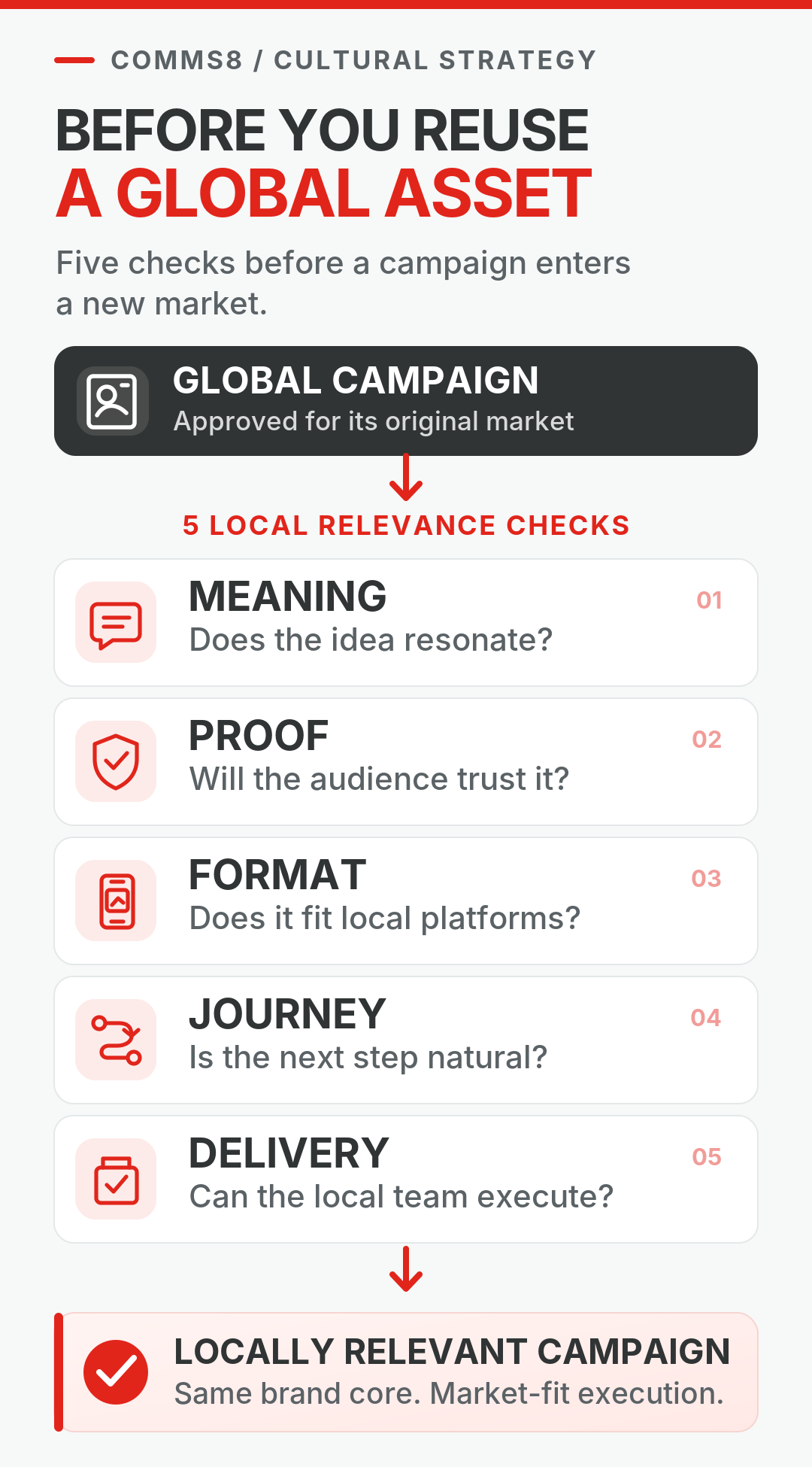
Before reusing an existing campaign asset, brands can assess it across five areas.
Meaning
Does the central idea make sense without relying on unfamiliar humour, values or cultural references?
Proof
Will the evidence, spokesperson and trust signals be recognised and valued by the intended audience?
Format
Does the asset fit the platform, content style and viewing behaviour of the market?
Journey
Does the call to action match the way customers discover, validate, enquire and purchase?
Delivery
Can the local team execute the campaign properly, respond to customers and apply learning after launch?
These checks can be incorporated into a practical workflow:
Define the audience and the commercial role of the market.
Identify which parts of the global strategy must remain fixed.
Review the original asset for cultural and operational assumptions.
Gather local insight before production begins.
Adapt the proposition, proof, format and next step where necessary.
Test the asset with appropriate local stakeholders or audience research.
Monitor both communication performance and commercial outcomes.
Localisation should not end when an asset is delivered. Media response, search behaviour, community questions and conversion quality can all show whether the adapted message is working. A coordinated media, search and performance activation plan helps turn those signals into further optimisation.
8. How Comms8 Connects Cultural Strategy with Local Execution
Cross-border campaigns often lose relevance in the gap between global strategy and local delivery.
The central team may understand the brand but lack market context. The local team may understand the audience but receive the campaign too late to influence it. Agencies may be responsible for individual channels without visibility across the full customer journey.
Comms8 helps brands close that gap by connecting:
Market and audience insight
Cultural strategy
Brand and content localisation
Platform and creator planning
Media, search and performance activation
Local execution and ongoing optimisation
The objective is not to remove the global idea. It is to identify which parts can travel, which must adapt and how the campaign should operate within the local market.
Western assets do not automatically fail in Asian or diaspora markets. They lose relevance when brands assume that clarity in the original market guarantees credibility everywhere else.
Successful localisation protects the brand’s core while rebuilding the message, evidence, format and journey around local behaviour. That makes the campaign more than understandable. It makes it useful, credible and easier to act on.
Planning a campaign across Asian or diaspora markets? Talk to Comms8 about cultural strategy, asset localisation and local execution.