
Cross-Border Marketing: How Brands Build Relevance Across East and West

One of the biggest mistakes brands make in cross-border growth is treating culture as a finishing touch. Culture is not simply another layer added to a campaign at the end. It can determine whether a brand has the credibility, relevance, and context to connect with a new audience in the first place.
This is why market entry cannot be reduced to translation. A message may be translated accurately and still lose its authority, emotional impact, or commercial meaning in another market. What works in one market may need to be reconsidered based on how audiences interpret brands, discover products, and make decisions.
East and West are not two uniform markets. Each has its own platform behaviour, creator ecosystem, media environment, search habits, and community expectations. These factors shape how audiences discover, evaluate, and ultimately trust a brand.
Cross-border marketing therefore requires both insight and execution. Cultural understanding should inform the strategy, while local activation turns that strategy into results.
Real cross-border marketing is the discipline of earning relevance before asking for demand.
1. Relevance Is Earned Before Demand Is Captured
Entering a new market does not automatically create demand. A brand may have strong awareness and an established reputation at home, but an unfamiliar audience may have little reason to trust it or understand why it is relevant.
Before demand can be captured, brands need to establish three things. At Comms8, we see these as the foundations of market relevance: cultural credibility, channel fluency, and trust:
Cultural credibility: Does the brand understand the local market and audience?
Channel fluency: Is the brand visible where customers actually discover and evaluate products?
A reason to trust: What evidence gives customers confidence in an unfamiliar brand?
Awareness is only the starting point. A campaign can generate impressions without creating consideration, and consideration does not necessarily lead to purchase.
This is particularly important when international brands compete with established local businesses. Brand recognition built in one market does not automatically carry the same authority elsewhere. The implication is simple: brands need to understand local behaviour, decision-making, platforms, and credibility signals before activation begins.
Relevance therefore needs to be earned before demand can be captured.
2. Translation Fixes Language, Not Meaning
Translation can make a campaign understandable. It does not necessarily make it persuasive.
The same message can carry different associations across markets depending on cultural context, consumer expectations, category norms, and how audiences evaluate brands.
Elements that may need adaptation include:
Brand messaging
Value propositions
Product benefits
Visual codes
Humour and tone of voice
Proof points
Authority signals
Calls to action
A claim that feels credible in one market may require additional evidence in another. A premium positioning may rely on different visual or linguistic signals. A direct call to action may also perform differently depending on how customers expect brands to communicate.
The question is therefore not simply:
“Can we translate this message?”
It is:
“Does this message carry the same authority, emotion, and commercial logic in this market?”
Effective localisation preserves the strategic intent of a brand while adapting how that intent is communicated. Culture should inform the thinking that shapes the campaign, not be added after the campaign has already been created. This is why content localisation requires more than translation, particularly when entering Chinese markets.
3. Discovery Does Not Follow One Global Funnel
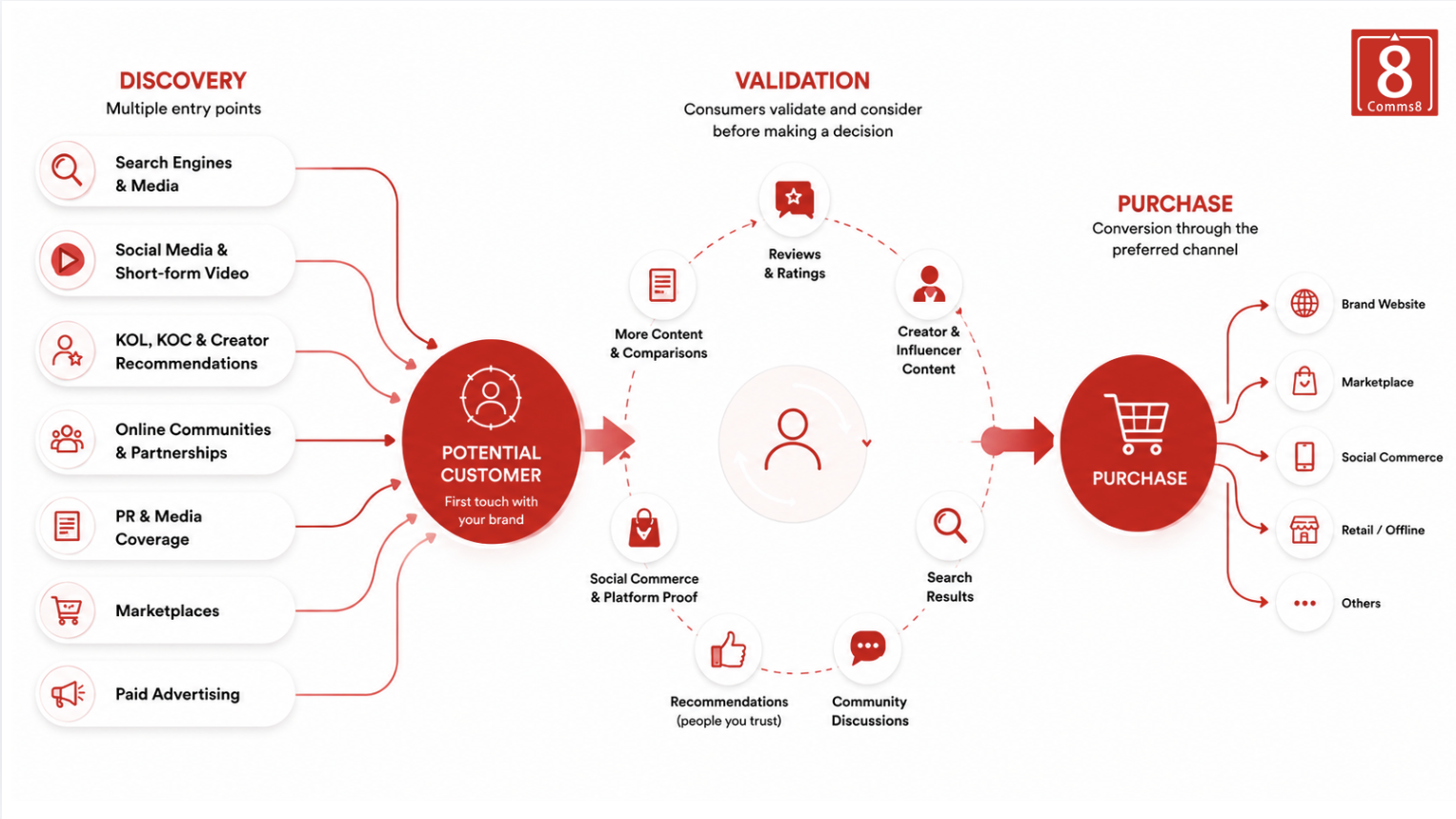
Consumers do not discover brands in the same way everywhere.
In many Western markets, search engines, social platforms, review sites, publishers, and professional networks can play distinct roles in the customer journey. Across many Asian markets, these behaviours can overlap more heavily with social search, creator content, community recommendations, marketplaces, commerce, and platform-native discovery.
This does not mean that all Asian or Western markets behave in the same way. Each market has its own platform ecosystem and consumer behaviour.
The important point is that there is no single global customer acquisition funnel. The same audience may move between search, social, creators, communities and commerce in a different sequence depending on the market. Understanding these pathways is critical to deciding where a brand should invest and what role each channel should play.
A customer might discover a brand through:
Search engines and media
Social media and short-form video
KOL, KOC, or creator recommendations
Online communities and partnerships
PR and media coverage
Marketplaces
Paid advertising
They may then validate that discovery through reviews, creator content, search results, community discussions, or recommendations before making a purchase.
For some audiences, search visibility may be critical at the consideration stage. For others, creator content, community proof, or social commerce may play a greater role.
The role of a cross-border marketing partner is therefore not simply to recommend channels. It is to understand how those channels work together within the local customer journey.
4. Trust Signals Are Market-Specific
Trust is one of the most important factors in market entry, particularly when consumers are unfamiliar with a brand. However, the signals that create trust vary by audience, category, and market.
Depending on the customer journey, trust may come from:
Industry credentials
Customer reviews
Media coverage
KOL and KOC recommendations
Brand heritage
Local partnerships
Certifications
Community recommendations
Search visibility
Customer service
B2B audiences, for example, may place greater value on credentials, industry expertise, media coverage, and established partnerships. Consumer audiences may respond more strongly to reviews, creator recommendations, community discussion, or demonstrations of product quality.
Deloitte US research highlights the role of creators in building this kind of relevance. Three in five consumers surveyed said they were more likely to recommend, purchase from, or explore products from a brand when a favoured creator endorsed it. The research also found that 50% more consumers were likely to purchase a product at a creator’s recommendation when they identified with that creator’s socioeconomic background. (Deloitte)
Customer experience also influences trust after discovery. PwC’s 2025 Customer Experience Survey found that 52% of US consumers had stopped using or buying from a brand because of a bad product or service experience, while 29% had done so because of poor customer experience online or in person. (PwC)
Trust, in other words, is not created by advertising alone. It is built across the customer journey. For cross-border brands, this means trust needs to be designed into the customer journey from the point of discovery, not added as a final layer of the campaign.
For brands working with creators across Asian markets, understanding the cultural context behind influencer marketing is equally important to choosing the right creator.
5. Localisation Needs Commercial Discipline
Culture matters, but localisation should not become cultural decoration.
Every adaptation should have a clear commercial purpose. A brand does not need to change everything when entering a new market. It needs to identify what should change to support the business objective while preserving what makes the brand distinctive.
This balance between global consistency and local adaptation is central to an effective cross-border marketing strategy.
Key decisions include:
Proposition
Does the existing value proposition address local priorities, or should certain benefits be reframed?
Media Mix
Which channels contribute to awareness, discovery, consideration, and conversion in the target market?
Content
Which messages, formats, creative concepts, visual codes, and content behaviours are relevant to the local audience?
PR
Which publications, experts, industry voices, and stories can establish credibility?
SEO and SEM
How do local audiences search? Which keywords reflect purchase intent? Which platforms and competitors dominate search visibility?
Influencer Strategy
Which KOLs, KOCs, and creators have genuine relevance and credibility with the target audience?
These decisions should connect directly to the business goal. If the objective is awareness, the strategy may prioritise reach, visibility, and brand association. If the objective is lead generation or sales, search intent, creator proof, conversion content, and performance media may require greater emphasis.
The goal is not to make a campaign look local. It is to make the marketing work locally.
Entering a New Market?
The right approach depends on what is already working, what needs to change, and how the market differs from your home market.
Discuss your market-entry challenge with Comms8
6. From Cultural Insight to Local Execution
A strong cross-border strategy needs to move beyond insight into practical activation.
This means understanding the audience, competitors, category, cultural context, platform ecosystem, and customer journey before deciding how to enter the market.
From there, brands need a clear plan covering:
Which audiences to prioritise
How the proposition should be positioned
Where demand is already being created
Which channels influence discovery and consideration
Which trust signals need to be established
How success should be measured
The execution may then span media, PR, creators, search, social, content, and other local platforms.
This principle becomes particularly important when global brands need to translate strategic intent into market-specific execution. AVEVA provides a practical example. To strengthen AVEVA’s presence in China, Comms8 combined audience-based programmatic targeting with location-based targeting, WeChat retargeting, and Baidu SEM. The approach connected global B2B positioning with the platforms and search behaviours relevant to the Chinese market. The results demonstrate the commercial impact of this localised approach: the campaign contributed 84% of total traffic to AVEVA’s China site and generated a £20.4 million business pipeline. (Comms8 - Cross-Border Marketing Agency)
The lesson is not that every brand needs the same channels. It is that market-specific insight should determine how a global brand is activated locally.
A strategy that ignores local execution will struggle to move the market. Equally, a busy media plan without cultural intelligence can waste budget quickly.
7. A Practical Cross-Border Market-Entry Checklist
Before entering a new market, ask:
Relevance: Do we understand the cultural and commercial context well enough to explain why this brand matters locally?
Trust: Do we know which credentials, proof points, creators, media, partnerships, or experiences will build confidence?
Discovery and demand: Do we understand where customers discover, compare, validate, and ultimately buy?
Measurement: Can we connect marketing activity to meaningful outcomes such as qualified traffic, leads, conversions, customer acquisition, or revenue?
The objective is not to make one global campaign work everywhere. It is to create a strategy that remains consistent with the brand while adapting to the realities of each market.
Global consistency provides the foundation. Local relevance creates the connection.
8. Building Cross-Border Growth with Comms8
Comms8 helps international brands build relevance across East and West by connecting cultural insight, media planning, and local execution.
We help brands turn market insight into practical marketing strategies, from positioning and media planning to search, social, creators, PR, and local platforms.
The AVEVA example demonstrates this approach in practice: the global brand remained consistent, while the media strategy, platform activation, and audience targeting were adapted to the realities of the Chinese market. The campaign contributed 84% of total traffic to AVEVA’s China site and generated a £20.4 million business pipeline. (Comms8 - Cross-Border Marketing Agency)
For brands entering a new market, the opportunity is not simply to translate existing demand. It is to build the relevance and trust that creates new demand.
Ready to explore your next market?
If you are planning market entry or looking to grow across markets, talk to Comms8 about your brief and how we can support your next stage of growth.
Download our credentials or get a quote to discuss your brief.