
Influencer Marketing in the Philippines: Why Brands Need a Market-Specific Creator Strategy

The Philippines is often included in a wider Southeast Asian creator plan. However, its combination of platform habits, multilingual communication, community influence, social commerce and overseas Filipino networks creates a distinct marketing environment.
English may reduce the initial barrier for international brands, but shared language does not guarantee shared cultural understanding. Effective influencer marketing in the Philippines depends on how local audiences discover products, whose recommendations they trust and how creator content moves from conversation to purchase.
Why the Philippines needs its own creator strategy
According to DataReportal’s Digital 2026 report, the Philippines had approximately 98 million internet users and 95.8 million active social media user identities in October 2025.
These figures indicate significant digital participation, but they require careful interpretation. Social media “user identities” may include multiple accounts belonging to the same person and should not be treated as a count of unique individuals. Similarly, advertising reach, adult-only audiences, registered members and monthly active users are different measures and cannot be compared directly.
For creator planning, audience estimates provide context—not a complete platform strategy. Brands still need to determine where their target customers discover products, evaluate recommendations and complete purchases.
Plan platforms by role, not headline audience size
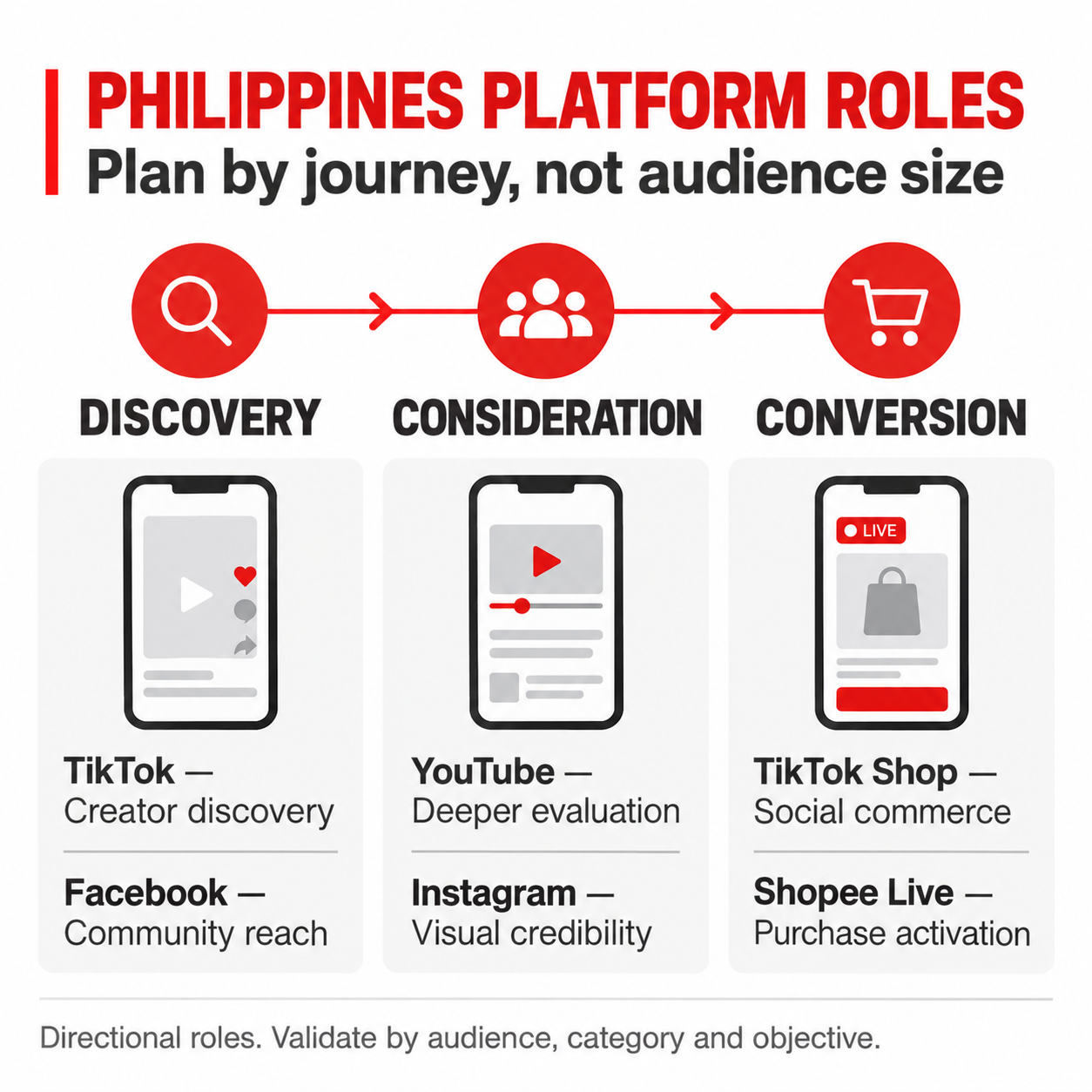
Research from Totem’s 2025 Philippines influencer marketing report suggests that Facebook leads consumer content consumption, with TikTok and YouTube also playing prominent roles. On the brand side, Instagram records strong influencer activity, while Shopee and TikTok Shop contribute more directly to commerce.
Brands can use these findings to develop the following directional planning hypotheses:
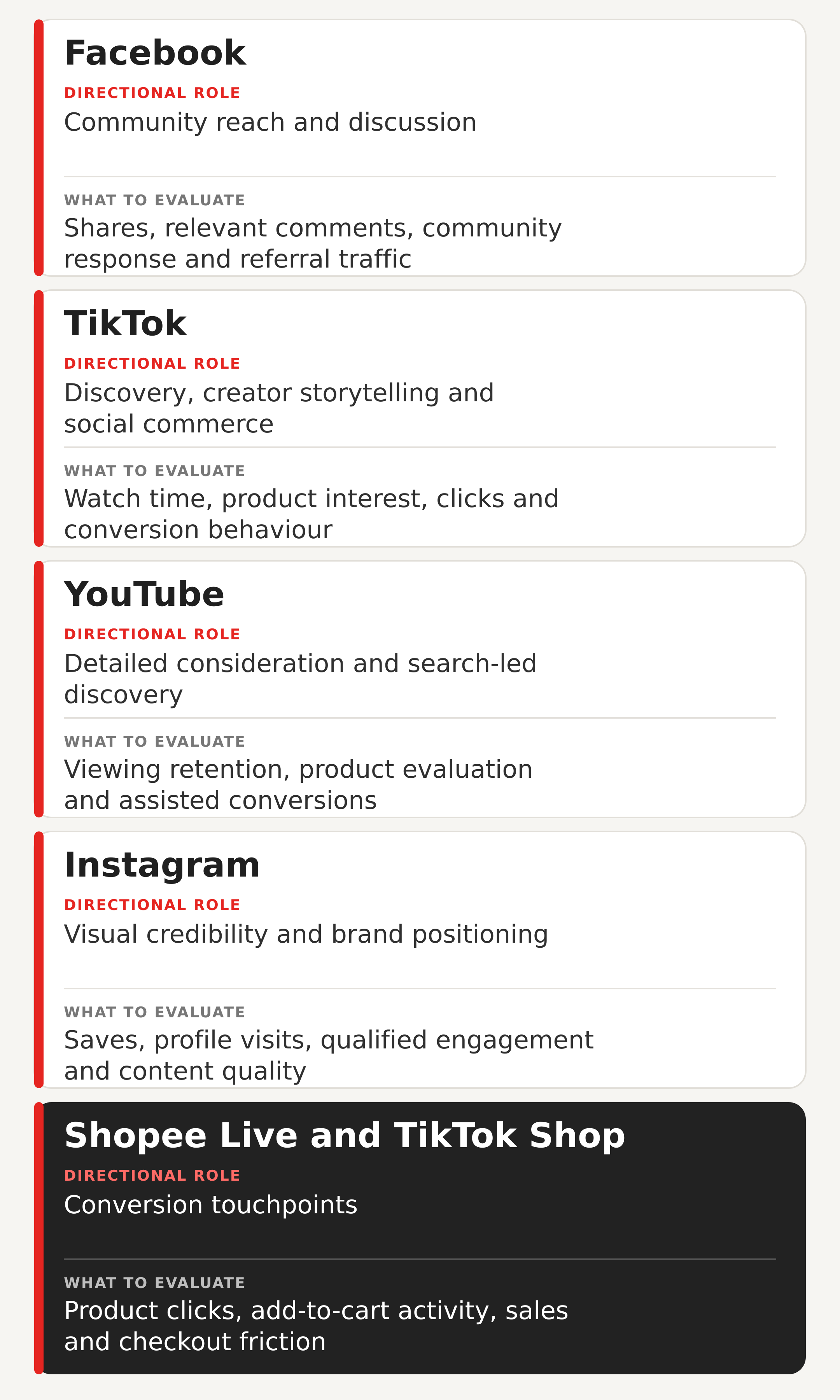
These roles are not a ranking of platform size. They should be tested against the audience, product category and campaign objective. Totem’s research included 526 Philippine consumers and 12 Philippines-based brand and marketing managers, so its findings are useful planning signals rather than market-wide performance guarantees.
Planning a creator campaign in the Philippines? Talk to Comms8 about building a market-specific strategy around your audience, platforms and commercial objectives.
Language access does not guarantee cultural relevance
Creator communication in the Philippines may shift between English, Filipino, Taglish and regional languages depending on the audience and context.
The objective is not to force every campaign into one language. It is to choose the language mix that allows the creator to communicate naturally with the intended community. English-led content may suit some professional or urban audiences, while Taglish or regional references can make other content feel more familiar.
Localisation therefore extends beyond translating captions. Humour, tone, examples, visual cues and responses to followers all influence whether a campaign feels credible. As discussed in Comms8’s guide to cultural context in Asian influencer marketing, brands need to understand the cultural expectations behind platform behaviour.
Community commerce connects trust with action
A distinctive characteristic of the Philippines is the close relationship between social interaction and shopping.
Totem reports that 85% of surveyed Filipino consumers had watched or purchased from a brand livestream. Among live-sale viewers, 66% had watched on Shopee Live and the same percentage had watched on TikTok Shop.
These percentages may overlap and are based on Totem’s 526-person consumer sample. They should not be interpreted as estimates for the entire Philippine population. However, they indicate how closely creator content can sit to the point of purchase.
Product demonstrations, livestream conversations, peer reactions and comment sections can help audiences evaluate a product before buying. Brands should therefore consider creator credibility and the wider conversion journey together.
A creator may generate strong interest but limited sales if the purchasing route is complicated. Campaign planning should connect content to a clear product page, suitable payment options and a straightforward checkout experience.
Choose creators by commercial role
Follower count alone does not explain what a creator can contribute. A more useful shortlist begins with the job the creator needs to perform.
An entertainment creator may generate attention. An industry expert can build authority around a complex product. A community creator may provide relatable demonstrations and social proof. A livestream host may be better equipped to answer objections and encourage immediate action.
Totem’s findings indicate that Philippine audiences respond to both expert endorsements and recommendations from family or peers. This supports a mixed creator approach in which authority introduces confidence and community-level voices make the product easier to understand and discuss.
Each creator should therefore be assessed against their intended role in discovery, consideration or conversion—not treated as an interchangeable media placement.
Diaspora networks can extend local influence
Philippine influence is not limited to audiences living within the country. Family relationships, creator communities and shared cultural interests connect domestic audiences with Filipinos living and working overseas.
The Philippine Statistics Authority estimated that 2.16 million Overseas Filipino Workers were abroad during the April–September 2023 reference period. This is a period-specific estimate of OFWs, not a measure of the entire Filipino diaspora, but it illustrates the scale of one transnational audience group.
For relevant categories, creator content may travel between domestic and overseas communities through recommendations, private messages and family conversations. This can create opportunities for travel, food, entertainment, financial services, telecommunications, beauty and gifting brands.
However, diaspora amplification should be planned rather than assumed. Brands need to establish whether overseas audiences can access the product, use the purchasing route and respond to the same proposition. They must also identify creators with credible connections to the priority communities and markets.
The Philippines Creator Strategy Map
Brands can organise campaign decisions around four connected areas:
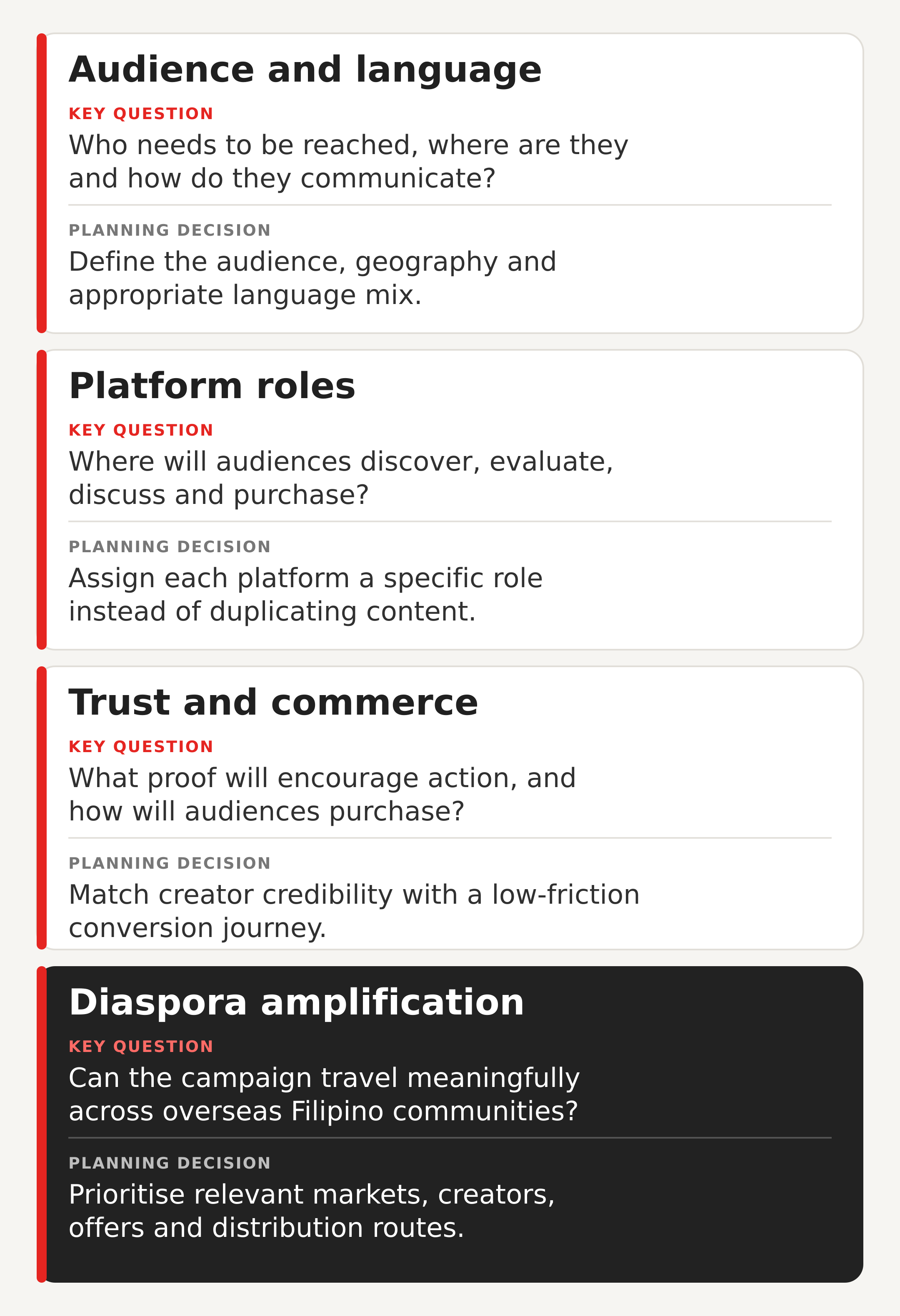
The map is not a fixed formula. Each area should be validated against the brand’s category, audience evidence and commercial objective.
Measure platforms against their assigned roles
Using the same KPI for every creator and platform can hide where value is being created.
Discovery content may be measured through qualified reach, watch time and search interest. Consideration content may require saves, relevant comments and product-page visits. Commerce activity should be connected to product clicks, add-to-cart behaviour, completed sales and checkout performance.
For diaspora activity, brands should also examine audience location, cross-market engagement and traffic from priority overseas communities.
Measurement should show whether each creator and platform completed its assigned job—not simply which generated the highest engagement rate.
Build for the market, not the regional template
Influencer marketing in the Philippines combines community-led product discovery, creator trust, social commerce and cross-border audience connections.
Brands that define platform roles, use language appropriately, select creators by commercial purpose and plan for diaspora amplification can build campaigns that are locally credible and commercially relevant.
Considering a creator campaign in the Philippines? Share your brief with Comms8 to develop a strategy connecting audience insight, cultural context and commercial activation.