
LINE Marketing in Japan: What Western Brands Still Misunderstand

Western brands often place LINE in the “messaging app” box. At Comms8, we believe that category is too narrow for the role it can play in Japan.
LINE had 100 million monthly active users in Japan as at 31 December 2025, according to LY Corporation’s January 2026 release. Scale alone does not explain its importance. LINE connects brand subscriptions, campaign messages, offers, service, loyalty and repeat engagement inside an environment people already use for everyday communication.
LINE does not replace search, public social platforms, ecommerce or a brand website. Its strategic value is often in connecting those touchpoints and maintaining the relationship after discovery.
The comparison with WeChat in 2015 is therefore useful—but only as a warning about category error. LINE is not WeChat, and Japan is not China. The parallel is that Western marketers can see a familiar chat interface, map it to WhatsApp or Messenger and miss the local consumer behaviour developing around it.
Effective LINE marketing in Japan starts with the journey: how people discover a brand, why they grant permission, what utility they receive, how they convert and what gives them a reason to return. That requires a market-entry and cultural strategy built around local behaviour rather than a global channel template.
1. LINE Is Not Japan’s WhatsApp
WhatsApp is a useful reference for private messaging. It is an incomplete reference for LINE’s role in Japan.
A LINE Official Account can support campaign and service messages, rich menus, coupons, reward cards, chat, step-based journeys and links to websites, apps or LINE MINI Apps. LY Corporation’s Official Account catalogue organises examples around these practical functions.
The relationship usually starts when a user adds an Official Account or otherwise chooses to interact. That makes the value exchange important. A creator video may create interest on YouTube, TikTok or Instagram; search may provide reassurance; LINE can then offer a useful next step such as a launch reminder, appointment, coupon, membership benefit or customer-service route.
One correction matters for current planning: LINE Pay in Japan ended on 30 April 2025. Brands should not design or depict a Japan journey that relies on an active LINE Pay checkout. Conversion may still involve a redemption, booking, enquiry, registration, store visit or purchase through another supported destination.
The point is not that every campaign needs every LINE feature. It is that LINE can influence more stages of the relationship than a messaging-only plan allows. This broader role makes LINE part of customer-journey design, not an add-on after the media plan is complete.
2. The WeChat 2015 Parallel Is About Ecosystem Behaviour
By the end of 2015, Weixin and WeChat had reached 697 million combined monthly active users. Tencent described Official Accounts as connecting users with content creators, merchants and advertisers while payments and services became more embedded in the ecosystem. These points are documented in Tencent’s 2015 annual results.
This does not mean LINE will follow the same path or offer the same functions. The lesson is that a local platform can look familiar at interface level while performing a different role in everyday consumer behaviour.
Western shorthand creates three recurring errors:
Feature matching: asking which Western app LINE most closely resembles.
Channel isolation: planning messaging separately from creators, media, promotion and CRM.
Public-metric bias: valuing visible engagement while overlooking opt-ins, redemptions, enquiries and repeat actions.
The more useful question is not “What Western app is LINE like?” It is “What jobs do Japanese consumers allow LINE to perform, and how should the brand earn a place in that relationship?”
3. LINE Changes the Creator and Media Brief in Japan
A Japan creator strategy cannot stop at public reach. YouTube, TikTok, Instagram and X may generate awareness, explanation or social proof, but another touchpoint may be needed to continue the relationship.
Creators can explain why following a brand on LINE is worthwhile. Depending on the campaign, the value could be a coupon, launch reminder, event update, booking route, member benefit, product guide or customer support. This changes the brief from “publish content” to “perform a defined role in the journey”.
Before creators are shortlisted, brands should specify:
The action expected after exposure
The value offered for adding the Official Account
The link, QR code or landing journey
The first message and follow-up sequence
The permissions, tracking and paid-usage requirements
Not every creator should drive a LINE opt-in. Some are better suited to awareness or category authority; others can credibly prompt action. A strong creator and influencer strategy assigns these roles before comparing follower counts.
Media must support the same journey. On 1 April 2026, LY Corporation launched the integrated LINE Yahoo Ads platform, enabling unified advertising delivery across LINE and Yahoo! JAPAN placements, according to the exact LY Ads integration release. This is a relevant market signal, not a reason to prescribe one media mix for every brand.
The strategic requirement is integration: public attention, creator influence, LINE opt-in and CRM should be designed as one path rather than handed between disconnected teams.
4. Trust Depends on Relevance, Rhythm, Utility and Permission
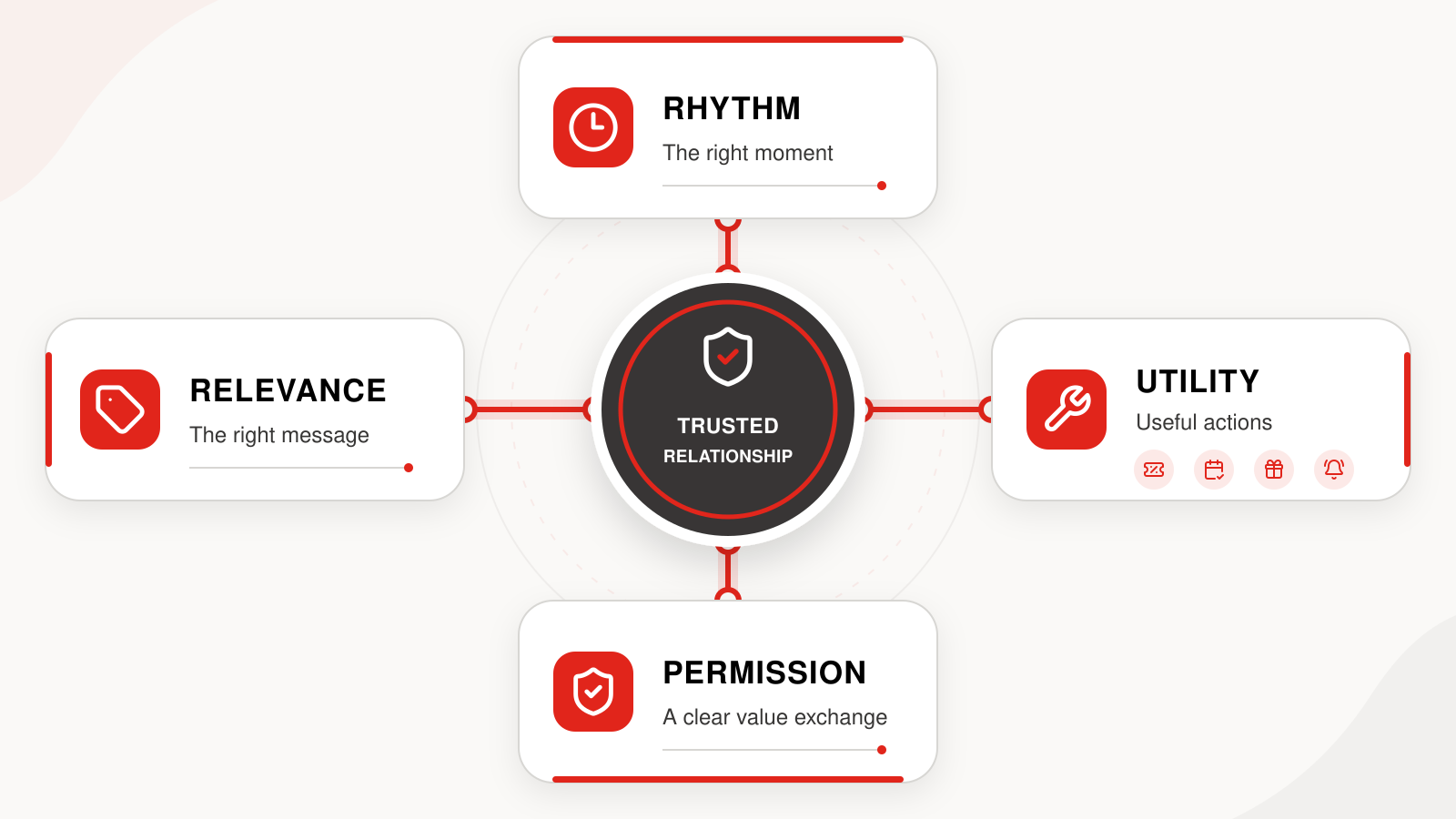
LINE’s proximity to personal communication creates opportunity, but it also raises the cost of poor execution. Translated promotional blasts may be technically correct and still feel intrusive.
A stronger strategy earns continued attention through four disciplines:
Relevance: Messages should reflect why the user followed. Someone who opted in for an event reminder should not immediately receive unrelated promotions.
Rhythm: Frequency should match the category, offer and stage of the relationship. More messages do not automatically create more value.
Utility: A coupon, booking shortcut, reward, product guide, service update or personalised next step gives people a reason to keep the connection.
Permission: Users should understand what they receive and what follows. LINE Login can connect a website or web app with a user’s LINE account and may present the option to add the related Official Account; these journeys require careful consent, data and implementation planning. See the official LINE Login documentation.
Tone matters across all four. Content localisation must account for politeness, clarity, seasonal context, information density and the brand’s position in the relationship. Translation alone cannot determine when a message feels helpful and when it feels intrusive.
5. What Western Brands Usually Get Wrong
The most common errors happen when LINE is added after the core campaign has already been designed.
Treating LINE as a translation task
Localising copy is necessary, but it does not solve audience segmentation, opt-in value, timing, promotional mechanics or follow-up.
Buying creator reach without designing the next step
A creator may deliver strong visibility, but momentum disappears if the destination is unclear or the LINE experience does not continue the promise made in the content.
Separating media from CRM
Media teams optimise exposure while CRM teams inherit an audience they did not help define. That disconnect makes acquisition cost difficult to connect with relationship quality and later action.
Ignoring local promotional mechanics
A coupon, reward, sticker or QR journey must fit the category, audience and local expectations. A mechanic copied from another market may acquire users who have little reason to remain.
Measuring only visible engagement
Views, likes and comments indicate attention. They do not show whether users added an account, redeemed an offer, booked, enquired, returned or blocked the account.
These are not simply platform-operation mistakes. They are customer-journey mistakes.
6. The Comms8 LINE Relationship Loop
Comms8 uses one connected framework to plan LINE within a Japan activation:
Discovery → Permission → Utility → Conversion → Return
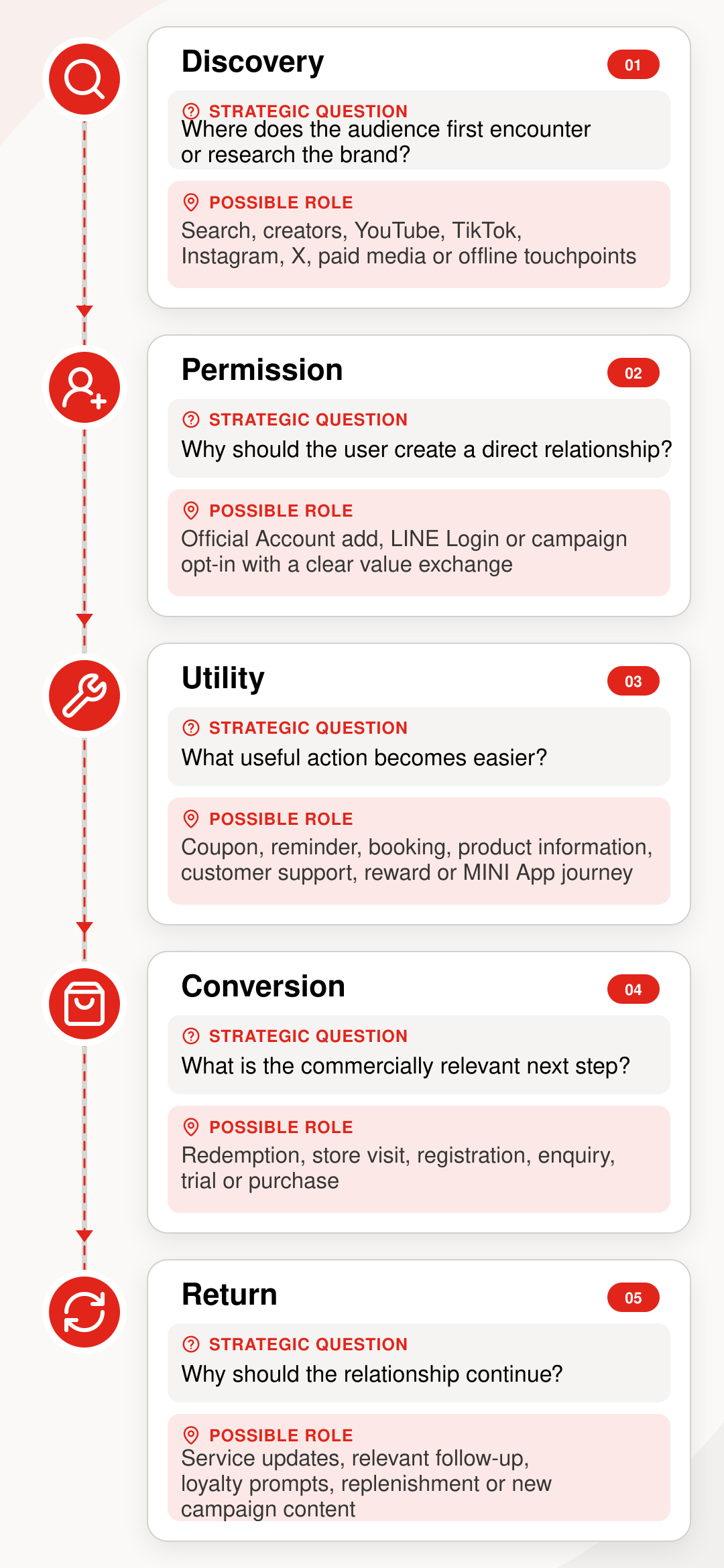
The loop keeps LINE connected to the full journey without treating it as either an afterthought or an isolated “super app” experiment. Its implementation rests on five decisions:
Map how the target audience discovers, evaluates and buys in Japan.
Define the role of creators, search, public social, paid media and LINE.
Design the opt-in value, first message and follow-up before acquisition begins.
Connect creator exposure and media spend with downstream actions.
Use performance data to improve segmentation, offers, creative and timing.
This is where social and community-led growth and media, search and performance activation need to meet.
7. How Comms8 Builds an Integrated Japan Activation
Comms8 helps brands enter, localise and scale across East and West through cultural strategy, social-first growth, media planning and local execution. In Japan, that means defining the consumer journey first, then assigning clear roles to LINE, creators, search, public social, media and CRM.
InfluenConnect supports this work as a creator-intelligence layer. Its Influencer Discovery tools can help teams identify and evaluate relevant creators using audience, performance, pricing and brand-fit signals. The creator shortlist supports the strategy; it is not a separate conversion destination for this article.
The goal is to connect four decisions that global teams often separate:
Market reality: how Japanese consumers discover, trust and respond
Platform role: what LINE and each public channel should achieve
Creator fit: who can communicate credibly and support the intended action
Commercial journey: how attention becomes permission, utility, conversion and return
LINE is not WeChat, and a China model should not be forced onto Japan. The deeper lesson from 2015 is that familiar labels become unhelpful when a local platform becomes part of everyday consumer infrastructure.
Successful LINE marketing in Japan begins when brands stop asking whether LINE is “Japan’s WhatsApp” and start designing the relationship it can support.
Planning a Japan activation? Talk to Comms8 about an integrated LINE, creator and media strategy.