
Baidu SEO in 2026: The Essential Guide for Foreign Brands Targeting Chinese Consumers
China remains one of the most commercially attractive digital markets, yet it operates under a fundamentally different search ecosystem. For foreign brands, success depends on adapting to Baidu SEO rather than relying on Google-centric assumptions. This guide outlines what has changed, what still matters, and how to build a practical Baidu SEO strategy that converts visibility into revenue.
If your objective is to generate qualified demand in China, this article is structured to move from fundamentals to execution and ultimately toward service adoption.
Why Baidu SEO Still Matters in 2026
Baidu continues to dominate China’s search landscape, reaching 50% to 60% market share between March 2025 to March 2026 (StatCounter, 2025). While competitors such as Shenma and Sogou exist, Baidu remains the primary entry point for product discovery, especially in B2B, education, healthcare, and premium consumer goods.
Unlike Google, Baidu’s algorithm prioritises:
Local hosting and regulatory compliance
Chinese-language content depth
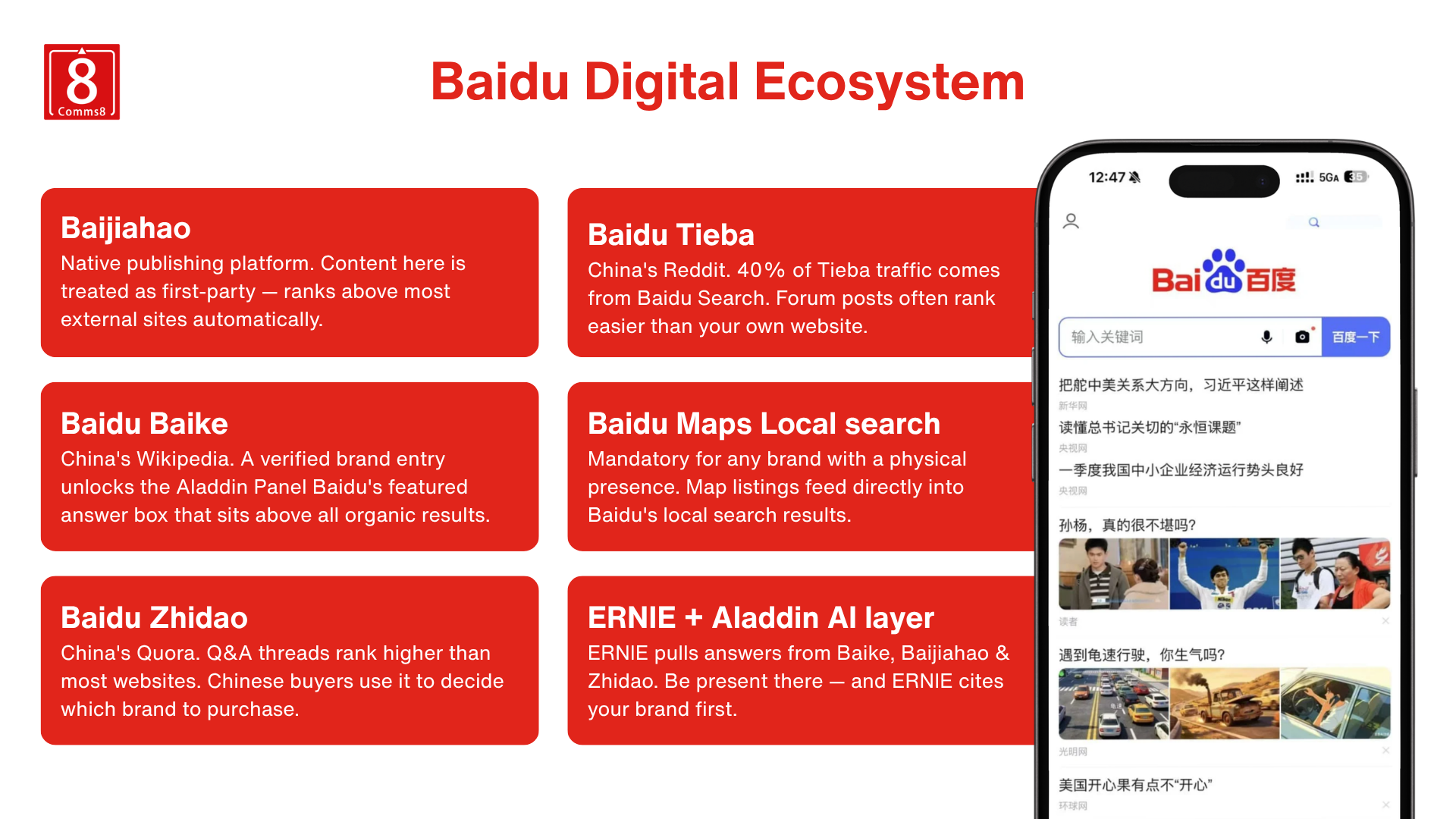
Platform ecosystem integration (Baidu Baike, Zhidao, Tieba)
Website speed within mainland China
For foreign brands, this means China SEO for foreign brands is not just about translation but about infrastructure, compliance, and cultural alignment.
To operationalise this effectively, most companies work with a dedicated partner. Comms8 provides a structured approach through its Baidu SEO Service Page:
Key Differences Between Google SEO and Baidu SEO
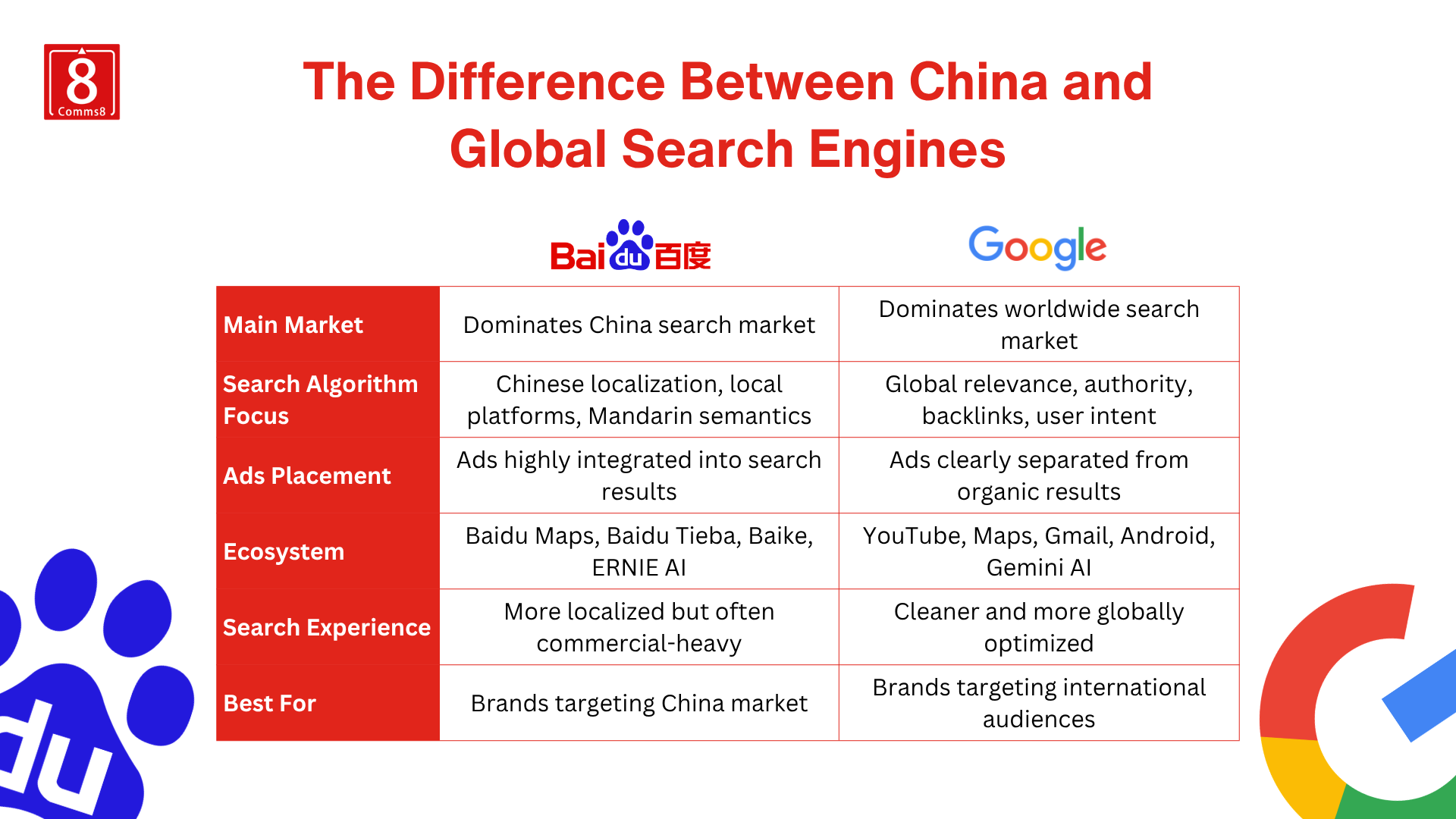
Understanding structural differences is critical before designing any Baidu SEO strategy.
1. Hosting and ICP Licensing
Baidu heavily favours websites hosted within mainland China. An ICP licence is often required for full indexing and ranking stability. Without it, even well-optimised content may underperform.
2. Language and Content Format
Simplified Chinese is mandatory. Direct translation is insufficient. Content must reflect search behaviour, tone, and cultural nuance, which is why China SEO for foreign brands often overlaps with localisation strategy.
3. Metadata and On-Page Signals
Baidu still relies heavily on meta keywords and descriptions, unlike Google. Title tags require tighter keyword alignment, reinforcing the importance of Baidu search engine optimization fundamentals.
4. Backlink Quality vs Quantity
Baidu historically valued quantity, but recent updates prioritise domain trust and relevance. Local Chinese domains (.cn) carry more weight.
5. Ecosystem Integration
Baidu properties such as Baike (encyclopedia) and Zhidao (Q&A) significantly influence rankings. A comprehensive Baidu SEO strategy includes presence across these platforms.When brand plan to eneteering china, they have to do the localisation of the conten, platform, and also the message. Becxaus ein 2027 wen need to do
Building a Baidu SEO Strategy That Converts
A high-performing Baidu SEO strategy in 2026 consists of five integrated layers:
1. Technical Foundation
Secure ICP licence
Host within mainland China or use CDN acceleration
Ensure fast load times under China network conditions
Technical optimization remains the baseline for effective Baidu search engine optimization.
2. Keyword Research Based on Chinese Search Behaviour
Keyword intent in China differs significantly from Western markets. Users often search with longer, descriptive phrases and trust informational content before transactional pages.
This is where China SEO for foreign brands requires local expertise, not just translated keyword lists.
3. Content Localisation and Authority Building
Content must demonstrate authority and relevance within the Chinese digital ecosystem.
Supporting strategies include:
Long-form educational articles
Industry-specific landing pages
Thought leadership content
4. Integration with Broader Marketing Channels
SEO in China does not operate in isolation. It intersects with:
Social media ecosystems
Influencer marketing
Paid search campaigns
Explore integrated execution and social platform dynamics for mastering SEO in China
The Role of AI and Search Evolution in China
Search behaviour in China is evolving rapidly with AI-driven interfaces and recommendation engines. However, unlike Western markets, Baidu’s transition is more ecosystem-based rather than purely generative.
AI influences:
Content ranking signals
Personalised search results
SERP feature expansion
Even with these changes, Baidu SEO fundamentals remain intact. Technical compliance, content relevance, and ecosystem authority still define performance.
Common Mistakes Foreign Brands Still Make
Despite increased awareness, several recurring issues limit performance:
Treating Baidu SEO as a direct copy of Google SEO
Ignoring hosting and regulatory requirements
Underinvesting in localisation
Failing to integrate SEO with wider China marketing channels
Expecting short-term results without ecosystem building
Each of these gaps weakens the overall Baidu SEO strategy and reduces ROI.
From Strategy to Execution
Executing Baidu search engine optimization at scale requires:
Local infrastructure setup
Native-language content production
Continuous algorithm monitoring
Cross-channel integration
For most foreign brands, internal teams lack the local expertise and operational capacity. This is why China SEO for foreign brands is typically outsourced to specialised agencies with on-the-ground experience.
Why Comms8
Comms8’s approach to Baidu SEO combines:
Technical compliance and infrastructure setup
Localised content strategy
Integration with paid media and social platforms
Continuous optimization based on real market data
Our service is designed not just for rankings, but for measurable business outcomes.
Key Takeaway for Brands
1. Baidu remains structurally different from Western search engines
2. Infrastructure and compliance are non-negotiable
3. Localisation goes beyond translation
4. Ecosystem integration drives authority
5. Content depth and trust signals outweigh volume
6. SEO must be integrated with broader China digital channels
7. AI is reshaping discovery, but not replacing fundamentals
8. Execution requires local expertise and operational capability
Conclusion
In 2026, Baidu SEO remains a critical acquisition channel for foreign brands entering China. However, success depends on a tailored Baidu SEO strategy that reflects local search behaviour, regulatory requirements, and ecosystem dynamics.
Companies that treat Baidu search engine optimization as a standalone tactic will struggle. Those that integrate it into a broader China digital strategy will generate sustained growth.
For more in-depth insights, follow Comms8 where we help your brand expand into foreign markets.
At Comms8, we specialise in helping businesses leverage the power of cross-border marketing in Asia. With our expertise, we can assist you in harnessing the influence of social commerce strategies to boost your brand’s credibility and awareness. Contact us today to learn more about empowering your brand in the dynamic market.