
Baidu SEM Agency: Paid Search Strategy and Campaign Management in China

Comms8 helps international brands enter or scale in China through Baidu paid-search programmes built for the local market. Our Baidu SEM services cover account readiness, Chinese-language keyword strategy, campaign architecture, bidding, landing-page recommendations, conversion tracking, optimisation and commercial reporting.
Baidu SEM is not a translated version of Google Ads. A campaign can fail before launch if the advertiser account, business documents, website, landing pages, keyword structure and claims are not ready for Baidu’s operating environment.
At Comms8, we treat paid search as part of China market entry and demand generation. The objective is not simply to buy clicks. It is to make relevant Chinese search demand visible, credible and measurable.
Why Baidu SEM Needs a Local Platform Strategy
Baidu reported that Baidu App reached 644 million monthly active users in June 2026. This figure measures Baidu App usage rather than search-market share, but it demonstrates the scale of the environment in which Baidu’s search and marketing products operate. Baidu Q2 2026 results
Scale does not make campaign planning transferable from Google. Chinese search demand sits within a different discovery and trust environment. A prospect may encounter a brand through search, check its Chinese website, look for local proof, consult industry media or social platforms, and return later through another channel. The paid-search plan therefore needs to align with the wider market-entry and cultural strategy.
The keyword logic also changes. A literal translation may preserve the dictionary meaning of a product category while missing how Chinese buyers describe the problem, compare suppliers or signal purchase intent. Brand terminology, technical language, abbreviations and regional phrasing may all require local research.
Baidu’s own search-advertising materials position search promotion around capturing expressed demand. Converting that demand still depends on the relationship between the query, advertisement, destination page and next action. More budget cannot repair a weak Chinese value proposition or an inaccessible landing page.
What Our Baidu SEM Service Covers
Comms8 provides an end-to-end service designed around the operational and commercial requirements of international brands.
Account readiness: We coordinate account-opening requirements, provide document checklists and support communication around advertiser verification.
Compliance preparation: We help review website, landing-page, keyword and advertising-material readiness. Specialist legal input may still be required for regulated sectors or specific claims.
Keyword strategy: We conduct Chinese keyword research, map search intent, review competitor visibility and develop match-type and negative-keyword frameworks.
Campaign architecture: We structure campaigns around markets, audiences, products, business lines, commercial priorities and levels of search intent.
Ad-copy localisation: We create native Chinese copy aligned with the intended query, brand positioning and platform requirements.
Bidding and budget planning: We establish initial bid logic, allocate budgets and define pacing rules and optimisation thresholds.
Landing-page recommendations: We review message alignment, mobile usability, page speed, trust signals, form design and the wider conversion journey.
Tracking and reporting: We support conversion setup, campaign dashboards, lead-quality review and recommendations for each optimisation cycle.
This work connects with Comms8’s wider media, search and performance activation capability. It can be delivered as a focused Baidu engagement or as one part of an integrated China growth programme.
Account and Compliance Readiness
Account setup should be treated as a workstream, not an administrative task left until launch week.
Baidu’s official account guidance states that registration information must be complete, company information should align with the website owner, controller or operator, and the registered root domain should match the domain used by keyword destination links. It also describes real-name registration and a one-company, one-website principle for an account. Baidu account requirements
In practice, readiness may involve:
Business registration and advertiser information
Website ownership and domain consistency
A working destination experience, with Chinese-language localisation recommended for relevance and conversion
Product, service and claim review
Additional documentation for restricted or regulated sectors
Accessible, mobile-appropriate landing pages
Clear contact details, privacy information and conversion routes
Baidu notes that keywords may be rejected when the associated content breaches applicable rules, the destination URL cannot be accessed, the keyword is insufficiently relevant to the page, the account appears to promote multiple companies, or another party’s trademark is used inappropriately. Baidu keyword review guidance
Approval timing should be planned with contingency. Baidu says that, after the required prepayment has been received and keywords have been added, an initial qualification review is processed within two working days. This is an initial platform timeline rather than a guarantee that every advertiser will be launch-ready within two days. Document questions, website changes or sector-specific requirements can extend the process. Baidu account application guidance
Comms8 provides operational guidance and coordinates campaign readiness. This does not constitute legal advice, and advertisers remain responsible for confirming their regulatory obligations and eligibility.
How We Set Up a Baidu SEM Campaign
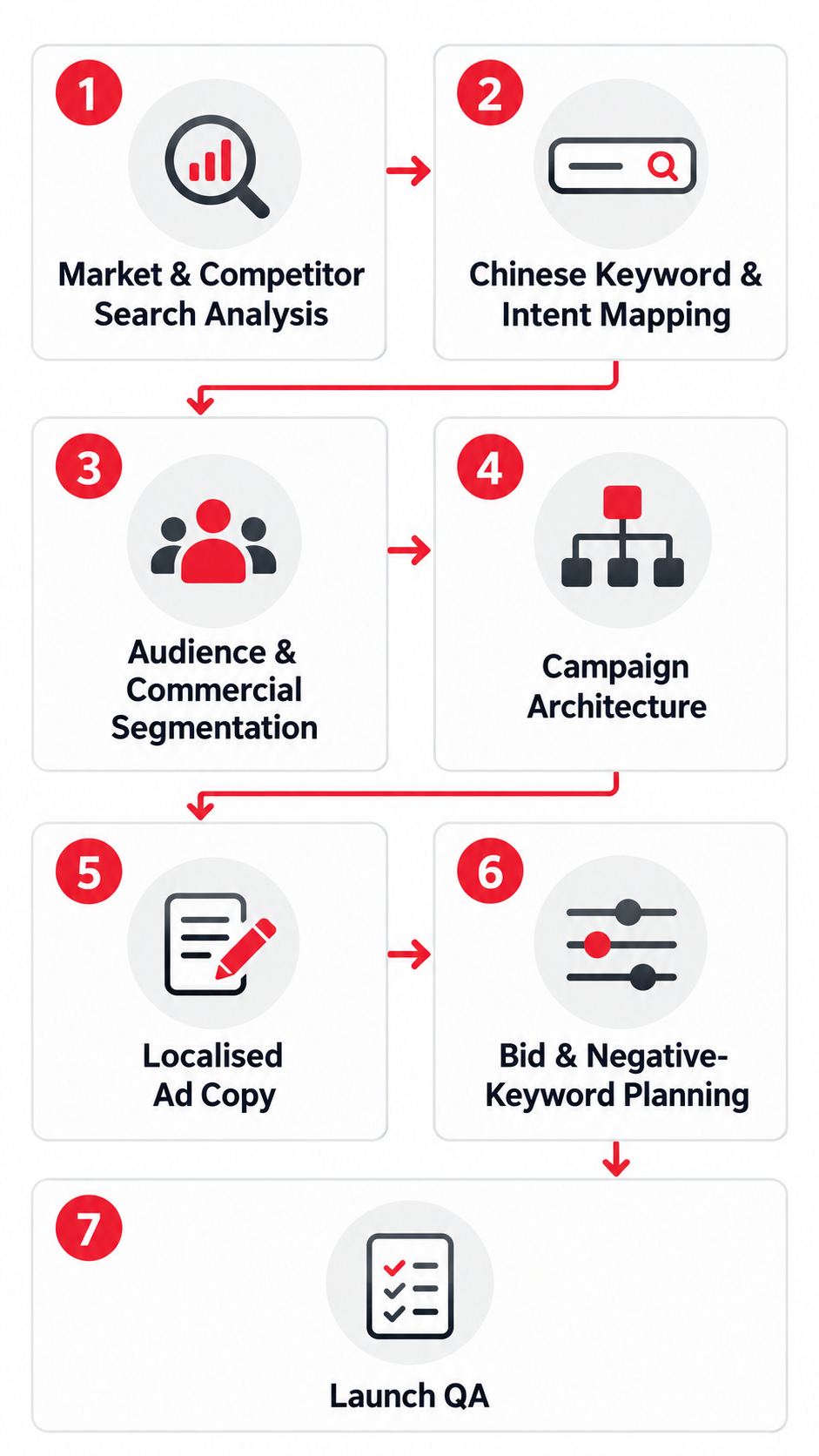
Our campaign setup process starts with demand and commercial priorities rather than a translated export of an existing Google Ads account.
1. Market and Competitor Search Analysis
We review category language, visible competitors, search-result patterns and the routes users encounter after searching. This helps establish whether the immediate opportunity is brand defence, category capture, lead generation, distributor support or a combination.
2. Chinese Keyword and Intent Mapping
Keywords are grouped by the job they perform: brand, problem, solution, product, comparison, sector, location or high-intent action. Native-language research identifies relevant terminology rather than assuming direct translation will carry the same intent.
3. Audience and Commercial Segmentation
We separate audiences where their needs, value or conversion routes differ. For B2B campaigns, this may include industry, use case, business function and location. For consumer campaigns, it may involve category need, product interest and geography.
4. Campaign Architecture
Campaigns and ad groups are built around clear themes so bids, copy, landing pages and budgets can be managed without mixing unrelated intent. Naming and tracking conventions are agreed before launch.
5. Localised Ad Copy
Our Chinese-language copywriting focuses on relevance, clarity and a credible next step. Content localisation is applied to the message, claims, proof and call to action—not only the language.
6. Bid and Negative-Keyword Planning
Initial bids reflect commercial priority, competition and the evidence available before launch. A negative-keyword framework is established early to reduce avoidable traffic and refined through search-term review.
7. Launch QA
Before activation, we check account status, keyword and ad approvals, destination URLs, mobile rendering, tracking, budget settings, conversion paths and reporting access.
Continuous Optimisation, Not Set-and-Forget Media Buying
Baidu SEM management continues after the campaign is approved. Early data shows which assumptions are holding and where the programme needs to change.
Our optimisation cycle can include:
Reviewing search terms and adding negative keywords
Adjusting bids and budgets by intent, location and performance
Testing Chinese advertising messages and calls to action
Reviewing keyword-to-page relevance
Identifying landing-page friction and mobile issues
Comparing conversion volume with lead quality
Monitoring budget pacing and delivery
Feeding search learning into SEO, content, PR and wider paid media
Landing-page quality is operationally important. Baidu’s published guidance identifies problems such as inaccessible pages, poor mobile adaptation, misleading interface elements and non-functional buttons. It also describes a diagnosis and resubmission process after issues are corrected. Baidu landing-page quality guidance
Where conversion-based bidding is used, tracking quality matters as much as bid settings. Baidu’s oCPC guidance explains how conversion tracking supports model learning and warns against making major changes during the learning period. Baidu oCPC guidance
Optimisation decisions should therefore be disciplined. A short-term fall in CPC is not automatically an improvement if it reduces qualified enquiries or sends traffic to a weak destination.
Reporting That Supports Commercial Decisions
Clicks, impressions, click-through rate and CPC remain useful operating metrics. They do not answer the full commercial question.
Comms8 reporting focuses on the information that helps marketing and commercial teams decide what to do next:
Search intent: We identify which keyword groups and search terms indicate early research, active comparison or a stronger likelihood of action.
Audience and location: We assess which available geographic and campaign signals are associated with stronger outcomes.
Landing-page performance: We review whether users reach, engage with and complete the intended action on the destination page.
Conversion quality: We monitor enquiries, calls, chats, downloads or other agreed actions, alongside sales feedback where it is available.
Budget efficiency: We assess spend, CPC, cost per conversion, pacing and the trade-off between conversion volume and commercial quality.
Next-step recommendations: We identify keywords to expand or exclude, messages to test, pages to improve and budgets to reallocate.
Lead-quality reporting works best when the client can return CRM or sales-stage feedback. Without that input, a platform conversion may indicate that a form was submitted, but not whether the enquiry was commercially relevant. We agree the feedback loop and data responsibilities before treating cost per lead as a business-quality measure.
Case Proof: AVEVA China
Sector: B2B industrial and engineering software
Challenge: Build AVEVA’s presence in Greater China, attract quality traffic to its China website and support lead generation in a competitive specialist category.
Approach: Comms8 combined programmatic targeting, WeChat retargeting and a cost-effective Baidu SEM programme using industry-related keywords and audience segmentation based on search behaviour.
Result: The integrated marketing strategy contributed 84% of total traffic to AVEVA’s China site, supported a £20.4 million business pipeline and delivered 16.9 million impressions. These are results from the integrated programme and should not be attributed to Baidu SEM alone. Read the AVEVA China case study
Get a Quote for Your China Paid-Search Programme
Connect Baidu SEM With Wider China Growth
Paid search performs more useful work when it is connected to the brand’s wider visibility and credibility in China.
Baidu SEO supports sustainable visibility for priority Chinese-language queries.
China SEO helps brands plan across the wider Chinese search environment and owned content.
China online advertising connects search with other paid-media opportunities across the market.
The right mix depends on the brand’s market maturity. A new entrant may need account and landing-page readiness before scaling media. An established advertiser may need restructuring, stronger keyword-to-page alignment or a reporting model that distinguishes enquiry volume from lead quality.
Why Comms8
Comms8 is a cross-border growth partner helping brands enter, localise and scale across East and West through cultural strategy, media expertise and local market execution. Our China paid-search work combines local platform knowledge, Chinese-language strategy, media activation and commercial measurement.
We help clients answer the questions that determine performance before and after launch:
Is the account and website ready for Baidu?
Does the keyword plan reflect Chinese search intent?
Do the advertisements and landing pages make the brand credible at the moment of demand?
Can campaign data be connected with meaningful business outcomes?
A Baidu SEM agency should do more than operate bids. It should help the brand build a compliant, credible and measurable route from search demand to commercial action.
Planning paid search in China? Get a quote from Comms8.