
APAC Digital Marketing in 2026: The Platform-by-Platform Playbook for Global Brands

The landscape of APAC digital marketing in 2026 is no longer defined by a single dominant market or platform. While China remains highly influential, the broader region including Southeast Asia, Japan, Korea, and Australia has evolved into a fragmented yet opportunity-rich ecosystem. For global brands, success now depends on executing a nuanced, platform-specific approach supported by strong localisation and integrated execution.
As outlined in Comms8’s previous analysis, the fundamentals of regional adaptation remain unchanged. However, platform dynamics, consumer behaviours, and commerce models have advanced significantly. This updated playbook expands that foundation into APAC marketing strategy in 2026.
Brands entering or scaling in the region should align early with capabilities such as Integrated Marketing, Chinese Digital Marketing Services, and a clear understanding of platform ecosystems via Social Media China Overview and Services Overview. These form the operational backbone of any effective brand expansion for APAC digital marketing.
The State of APAC Digital Marketing in 2026
The scale of APAC digital marketing continues to expand rapidly:
Southeast Asia’s internet economy is projected to exceed $300 billion GMV by 2025–2026 (Bain & Company).
Social commerce in China alone is expected to reach $4.22 trillion by 2026 (Research and Markets).
Over 70% of Chinese consumers have purchased through social or livestream platforms (USA Department of Commerce)
Livestream commerce is projected to surpass $1 trillion globally, with APAC leading adoption (SEO Agency China)
These figures indicate a structural shift across Southeast Asia and China digital marketing: Content is no longer a support function, it is the primary driver of discovery and conversion.
Platform-by-Platform Playbook
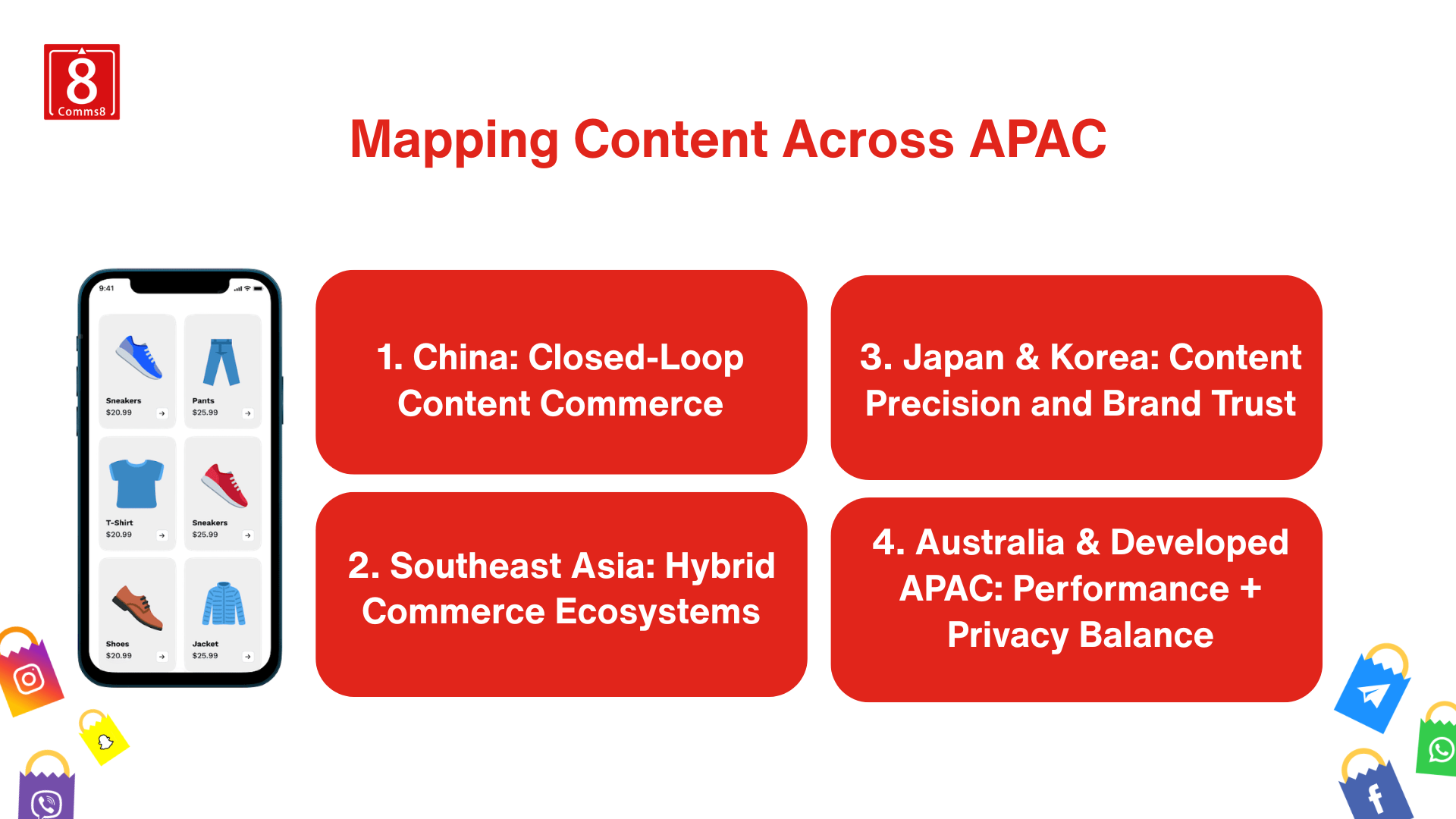
1. China: Closed-Loop Content Commerce
China remains the most advanced environment for APAC digital marketing, particularly in commerce integration.
Key platforms inclueds:
Douyin
Xiaohongshu (RED)
Kuaishou
Core characteristics:
Fully integrated purchase journeys (content → checkout)
Algorithm-driven discovery (interest-based, not follower-based)
High adoption of livestream commerce
From the source document:
600M+ daily active users on Douyin (USA Department of Commerce)
Social commerce contributes over 16% of total e-commerce
China Livestream commerce already exceeded $695 billion and is growing rapidly (2024)
For APAC brand expansion, China serves as the benchmark for future platform convergence. Some supporting capabilities can be helpful such as:
Influencer execution via https://www.comms8.com/influencer-marketing
Cultural adaptation via https://www.comms8.com/blog/2025/cultural-context-in-asia-the-secret-to-influencer-marketing-success
2. Southeast Asia: Hybrid Commerce Ecosystems
Unlike China’s closed systems, Southeast Asia digital marketing operates across interconnected but fragmented platforms.
Key platforms:
TikTok Shop
Shopee Live / Lazada Live
Instagram / Facebook
Trends shaping APAC marketing strategy 2026:
TikTok Shop driving social commerce adoption across Indonesia, Thailand, and Vietnam
Heavy reliance on marketplaces combined with social discovery
Rapid growth of creator-led selling
This implication: brands must design for cross-platform journeys rather than single-platform dominance. A relevant strategy like social commerce integration can be useful
3. Japan & Korea: Content Precision and Brand Trust
In mature markets like Japan and South Korea, APAC digital marketing is less about rapid conversion and more about brand equity and precision targeting.
Key platforms:
LINE (Japan)
Kakao (Korea)
YouTube and Twitter/X
Distinct characteristics:
Higher expectations for content quality and brand credibility
Strong role of community platforms and messaging apps
Lower tolerance for overtly commercial content
For brand expansion APAC, these markets require deeper localisation and long-term positioning rather than aggressive performance marketing.
4. Australia & Developed APAC: Performance + Privacy Balance
Markets like Australia and Singapore reflect Western-style ecosystems with increasing regulatory pressure.
Key platforms:
Google
Meta platforms
TikTok (growing influence)
Key considerations:
Data privacy regulations shaping targeting strategies
Continued importance of paid media efficiency
Integration of creator content into performance campaigns
This segment reinforces the need for a balanced APAC marketing strategy 2026 combining brand and performance.
Cross-Regional Strategic Shifts
1. Content as the Core Conversion Engine
Across all markets, APAC digital marketing has shifted toward content-led ecosystems:
Short-form video drives awareness
Livestream drives urgency
Influencers drive trust
Integrated checkout drives conversion
This is most advanced in China but increasingly visible across Southeast Asia digital marketing.
2. Localisation Beyond Language
Effective brand expansion APAC requires adaptation at multiple levels:
Cultural references
Visual storytelling
Platform behaviour norms
Failure to localise remains one of the primary causes of underperformance.
3. Integrated Paid and Organic Strategy
Organic reach remains powerful, particularly in algorithm-driven platforms. However, scaling requires paid amplification.
Best practice:
Use organic content to validate messaging
Amplify high-performing assets through paid media
Align with platform-native ad formats
The Role of Social Commerce in APAC Growth
The convergence of content and commerce is the defining feature of APAC digital marketing in 2026.
From the provided document (China example):
Consumers increasingly discover products through content, not search
Livestreams significantly outperform traditional e-commerce conversion rates
Seamless checkout reduces friction and accelerates purchase decisions
This model is rapidly expanding into Southeast Asia digital marketing, particularly through TikTok Shop and live marketplace integrations.
Building an Effective APAC Marketing Strategy 2026
A structured APAC marketing strategy 2026 should include:
Platform-specific execution plans
Localised content production pipelines
Influencer ecosystem development
Integrated commerce strategy (good content = checkout from customers)
Continuous data optimisation
Crucially, there is no single “APAC strategy.” Execution must reflect regional diversity while maintaining central coordination.
Conclusion
APAC digital marketing in 2026 is defined by fragmentation, speed, and platform innovation. China continues to lead in content-commerce integration, while Southeast Asia scales rapidly through hybrid ecosystems. Mature markets demand precision and trust, and all regions require strong localisation.
For global brands, the opportunity lies not in replication but in adaptation. A successful brand expansion APAC approach depends on understanding platform roles, aligning content with commerce, and executing with cultural relevance.
Those that treat APAC as a unified but flexible system, rather than a single market that will be positioned to capture sustained growth.
Key Takeaways for Global Brands
1. APAC digital marketing is no longer a single-market strategy
APAC digital marketing in 2026 requires region-specific execution. China, Southeast Asia, Japan, and Australia operate on fundamentally different platform ecosystems, consumer behaviours, and conversion models. A unified strategy must be centrally coordinated but locally executed.
2. Content has become the primary driver of commerce
Across both China and Southeast Asia digital marketing, content is now directly linked to conversion. Short-form video drives discovery, while livestream and creator content accelerate purchase decisions. This shift should be central to any APAC marketing strategy in 2026.
3. Video commerce is scaling rapidly across Southeast Asia
According to Google–Temasek–Bain, video commerce already contributes a significant share of e-commerce GMV in the region and continues to grow quickly. This signals a structural shift in Southeast Asia digital marketing, where entertainment and transactions are increasingly integrated.
4. Platform strategy must be tailored, not duplicated
Each platform plays a distinct role:
China: closed-loop ecosystems (e.g., Douyin, Xiaohongshu)
Southeast Asia: hybrid ecosystems (TikTok Shop + marketplaces)
Japan/Korea: trust-driven, content precision
Australia: performance-led with privacy considerations
Effective brand expansion APAC depends on aligning strategy with these platform-specific dynamics.
5. Influencer ecosystems are now core infrastructure
Influencers are no longer campaign add-ons but essential distribution channels. A strong APAC marketing strategy 2026 includes long-term creator partnerships, micro-influencer networks, and platform-native storytelling to drive both reach and trust.
6. Localisation determines performance
Successful APAC digital marketing goes beyond translation. Brands must adapt messaging, visuals, and narratives to local cultural contexts. Without this, even well-funded campaigns underperform across diverse APAC markets.
7. Social commerce models are converging across the region
China remains the most advanced, but its “content-to-commerce” model is rapidly influencing Southeast Asia digital marketing. The gap between discovery and purchase is shrinking across platforms, making seamless user journeys a priority.
8. Paid and organic strategies must work together
Organic content builds credibility and engagement, while paid media scales reach. High-performing brands in APAC digital marketing integrate both into a unified system rather than treating them separately.
9. Data and testing are critical for scaling
Given platform fragmentation, there is no fixed formula for success. Continuous testing, local insights, and market-specific optimisation are essential for sustainable brand expansion APAC.
10. The competitive advantage is adaptability
The APAC landscape evolves faster than most global regions. Brands that continuously adapt their APAC marketing strategy 2026 across platforms, formats, and cultural trends will outperform those relying on static global playbooks.
For more in-depth insights, follow Comms8 where we help your brand expand into foreign markets.
At Comms8, we specialise in helping businesses leverage the power of cross-border marketing in Asia. With our expertise, we can assist you in harnessing the influence of social commerce strategies to boost your brand’s credibility and awareness. Contact us today to learn more about empowering your brand in the dynamic market.