
KOL Marketing in China: The Complete Brand Guide for 2026
Social media is no longer just a channel for communication, it is deeply integrated with entertainment, search, commerce, and everyday decision-making. For brands looking to enter or scale in this environment, KOL marketing China plays a central role in how products are discovered, evaluated, and purchased.
For brands unfamiliar with how these ecosystems connect, it is useful to first understand the broader platform landscape and user behaviour. A structured view like chinese social media platforms such as Douyin, WeChat, and Xiaohongshu play different but complementary roles in the consumer journey. Similarly, approaches such as Influencer marketing in China differ significantly from global norms, as they are closely tied to commerce infrastructure rather than just content distribution.
Data from DataReportal showed that China had over 1.11 billion internet users and more than 1.08 billion social media identities as of 2025, with short video and livestreaming dominating user behaviour. Within this landscape, a key opinion leader China strategy operates inside a highly saturated but opportunity-rich environment where attention is abundant, but trust is selective.
Why KOL Marketing China looks different in 2026
The biggest mistake global brands still make is assuming China works like a translated version of Instagram, TikTok, or YouTube. It does not. Chinese platforms are more tightly woven into search, social proof, chat, payment, and purchase behaviour, which means KOL marketing China sits much closer to the point of sale than in many Western markets. The combined MAU for Weixin and WeChat at 1.418 billion as of 31 December 2025 (Tencent, 2026), while official U.S. Department of Agriculture analysis says China’s livestreaming e-commerce market reached about $807 billion in 2024, with 833 million livestreaming users and projected 18% CAGR through 2026.
That is why a winning Chinese KOL strategy in 2026 is not just about awareness. It is about mapping creators to the actual Chinese buying journey: discovery on short video, validation through comments and community, conversion through livestream or native checkout, and retention through private traffic on WeChat and brand-owned channels. If your campaign plan stops at “book an influencer and post content,” it is too shallow for how Chinese consumers actually shop.
KOL, KOC, and why the distinction matters
The most common brief we hear from international brands is simple: “We need influencers in China.” The better question is KOC vs KOL China: who is building reach, who is building trust, and who is actually closing sales?
A useful way to think about it is this. A key opinion leader China partnership is usually best when you need fast visibility, category authority, and a stronger signal to the market that your brand belongs in the conversation. KOLs are especially effective when you are entering a new category, launching a premium offer, or trying to compress awareness-building into a short campaign window.
A KOC vs KOL China plan becomes more powerful when you add Key Opinion Consumers for proof, review-style storytelling, and peer-level credibility. KOCs often outperform bigger names when the buying decision depends on detail, relatability, or repeat exposure rather than celebrity pull alone. The distinct roles of KOLs and KOCs in China’s creator ecosystem, which is one reason brands should not rely on a single creator type. (Lefty,2024)
For most mid-market brands, the right answer is not celebrity-first. It is a Chinese KOL strategy built in layers: a small number of authority creators for reach, a wider KOC group for social proof, and always-on owned content to carry the message after the campaign spike. That approach is usually more affordable, more culturally grounded, and more scalable than chasing one expensive face.
The real 2026 shift: store-led and commerce-led creator strategy
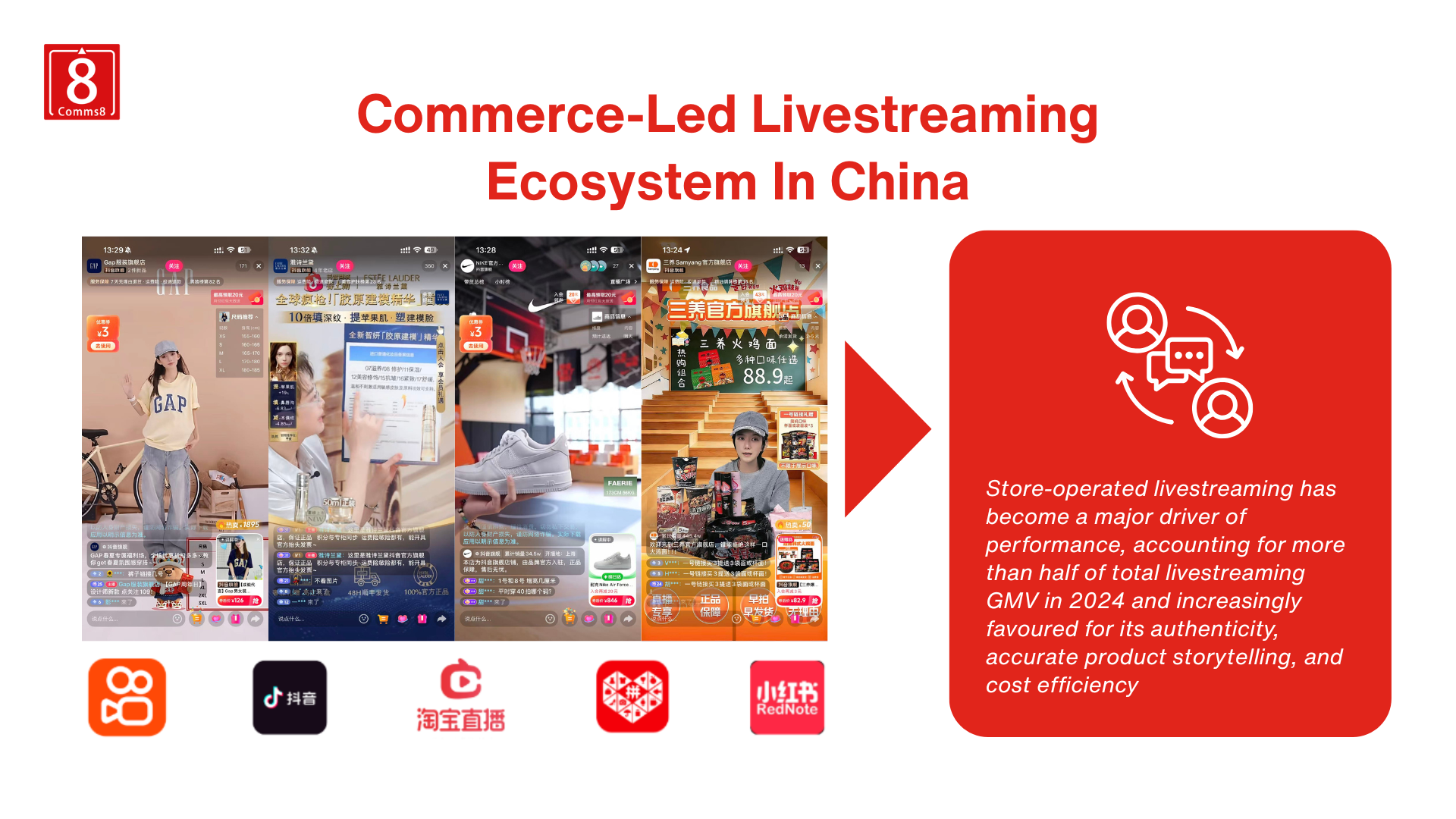
One of the most important changes for 2026 is that brands no longer need to depend entirely on expensive mega-creators. Store-operated livestreaming has become a major driver of performance, accounting for more than half of total livestreaming GMV in 2024 and increasingly favoured for its authenticity, accurate product storytelling, and cost efficiency (USDA, 2025). For mid-market teams, this shift is redefining how KOL marketing China budgets are structured and optimised.
This is where KOC and KOL in China becomes a strategic lever rather than just a content choice. Instead of relying on a single creator type, brands are now combining roles to balance reach, trust, and conversion more effectively:
KOLs → drive visibility and market entry impact
KOCs → build credibility through relatable product experience
In-house or brand hosts → convert through education-led livestreaming
This layered approach helps brands avoid overpaying for top-tier exposure when the real objective is sustainable, repeatable conversion.
It also explains why a key opinion leader China brief must now go beyond audience demographics. Operational fit has become just as important as reach. Brands should evaluate:
Livestream capability and on-camera performance
Ability to drive traffic into private ecosystems (e.g. WeChat)
Compatibility with store-led or always-on content strategies
Understanding of local culture, humour, and platform-native formats
These considerations are what separate short-term campaign activity from long-term market traction.
Platform choices: where each role works best
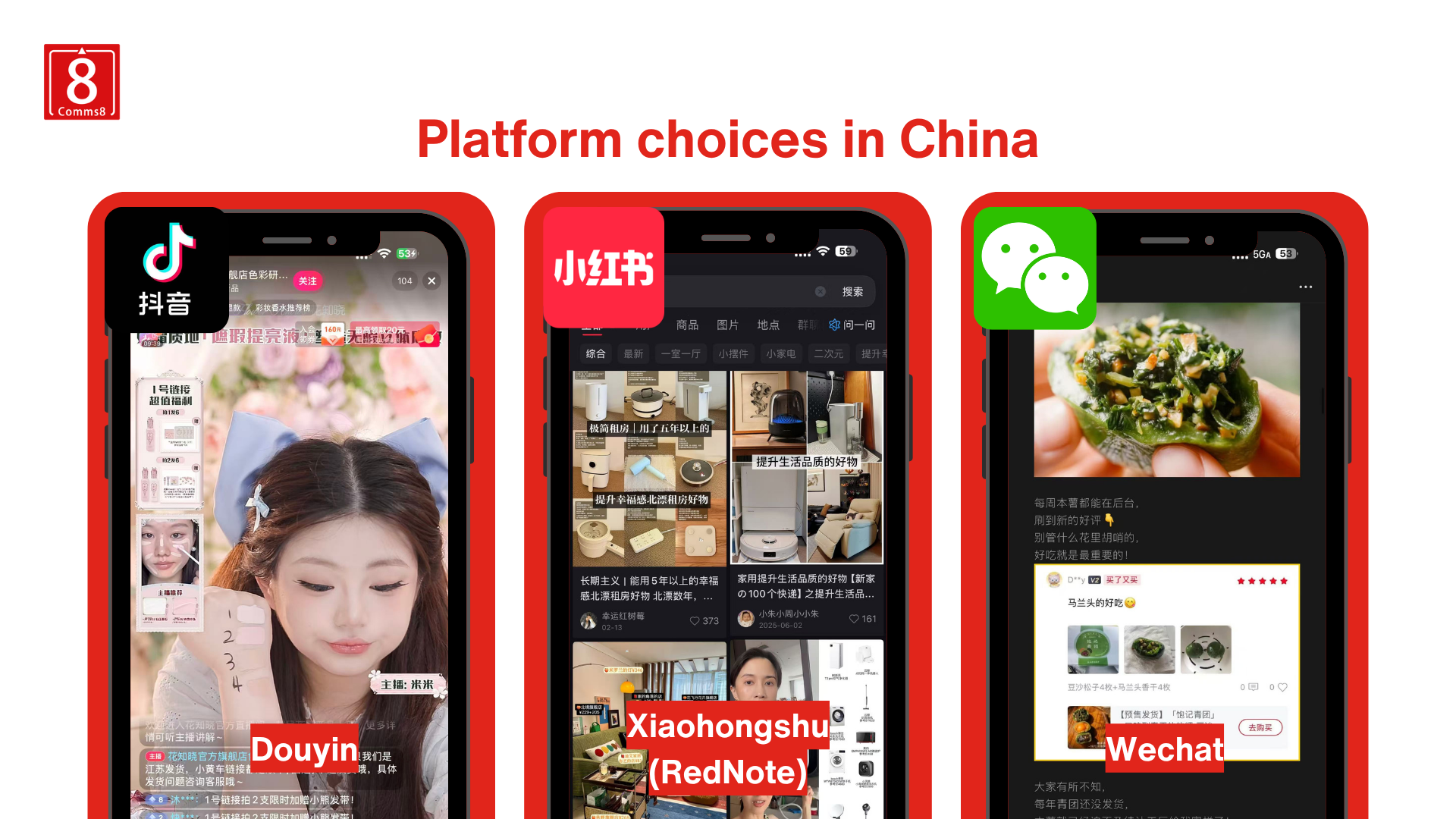
The best Chinese KOL strategy is always platform-specific, as each platform plays a distinct role in the consumer journey:
Best for scale, fast reach, and strong commerce momentum
Combines short video and livestream for seamless conversion
Held the largest share of livestreaming e-commerce GMV, reaching around $487 billion.
Ideal as a core performance platform for growth-stage brands
Best for retention, private traffic, and long-term customer relationships
Integrates content, CRM, Mini Programs, and transactions in one ecosystem
Shipinhao (video channel) connects discovery with owned channels
Supports repeat purchase and community-driven brand building
Best for trust-building, product discovery, and lifestyle positioning
Highly effective for categories driven by peer validation and search behaviour
Strong platform for KOCs and review-style content
Plays a key role in influencing consideration before purchase
Culture is not decoration. It is performance.
Many global brands still localise too late. They approve a global concept, translate captions, and then wonder why engagement looks polite but weak. In China, culture is not a finishing touch. It shapes humour, status cues, gifting logic, trend cycles, and what “authentic” even sounds like on each platform.
That is why a KOL campaign should begin with localisation, not translation. The creator brief, comment moderation, keyword framing, offer structure, and visual references all need to feel native to the platform and the audience segment. Cultural context in Asia explains why regional nuance changes performance, and our content localisation work helps brands operationalise that nuance rather than treat it as theory.
The same rule applies to broader channel planning. Your creator work will perform better when it is connected to china online advertising, integrated marketing, and a wider content ecosystem rather than being asked to carry the whole launch alone. Creator campaigns work best when paid, owned, and earned media are reinforcing the same local insight.
Compliance now matters even more
Another reason 2026 requires a sharper Chinese KOL strategy is regulation. China’s new Measures for the Supervision and Administration of Livestreaming E-commerce were issued in December 2025 and took effect on 1 February 2026 (Digital Policy Alert, 2026). The rules require platform operators to verify real identity information for livestream participants, retain transaction-related information for at least three years, train livestream marketing personnel, and take steps against false or misleading commercial information, including misuse of AI.
For brands, that means a KOC vs KOL China decision cannot be separated from governance. You need clear contracts, disclosure standards, claims review, product substantiation, record keeping, and local oversight. The cost of getting this wrong is not just wasted media spend; it is platform risk, reputational damage, and compliance exposure at the moment you are trying to scale.
What a practical 2026 playbook looks like
First, get market and platform fit right. China creator economy 2025 gives a useful snapshot of the landscape, but the key move is choosing the platform that matches how your category is bought, not the platform your HQ team happens to know best.
Second, build the creator mix deliberately. A key opinion leader China layer creates relevance and visibility. A KOC layer builds social proof and searchable review content. Store-led or founder-led livestreaming then closes the gap between inspiration and purchase, especially for mid-market brands that need efficient growth.
Third, define success properly. The strongest campaigns do not report only on views. They measure saves, search lift, comment quality, click-through, add-to-cart, livestream conversion, private-domain growth, repeat purchase, and content re-use value across owned channels.
Finally, connect creator work to the rest of your China stack. The best results come when campaigns support product launches, channel promotions, community building, distributor relationships, and long-term market education instead of being treated as a standalone burst.
Conclusion: Winning with KOL Marketing China in 2026
As China’s digital ecosystem continues to evolve, KOL marketing China is becoming less about one-off influencer campaigns and more about building an integrated, commerce-driven growth engine. Success in 2026 will depend on how well brands balance cultural understanding, platform strategy, and creator collaboration across the full customer journey.
Rather than chasing visibility alone, brands that win are those that combine influence with infrastructure connecting content, community, and conversion in ways that feel native to the Chinese market.
Key Takeaways for Brands
Build a Chinese KOL strategy that integrates awareness, trust, and conversion—not just reach
Understand the role of KOC and KOL in China and use both strategically to balance credibility and scale
Prioritise platform-native execution across Douyin, WeChat, and Xiaohongshu
Invest in localisation. Content should be culturally relevant, not just translated
Leverage livestreaming and store-led content to drive measurable ROI
Ensure compliance and operational readiness as regulations continue to evolve
Think long-term: sustained engagement outperforms short campaign bursts
For more in-depth insights, follow Comms8 where we help your brand expand into foreign markets.
AtComms8, we specialise in helping businesses leverage the power of cross-border marketing in Asia. With our expertise, we can assist you in harnessing the influence of social commerce strategies to boost your brand’s credibility and awareness. Contact us today to learn more about empowering your brand in the dynamic market.