
Social Commerce in China 2026: How Global Brands Are Turning Content Into Sales
China is not merely a leader in social commerce; it is setting the benchmark for the industry. In 2026, content is not about marketing; it is the storefront, the sales funnel, and the conversion engine all in one.
For global brands and creators alike, understanding how to get discovered as an influencer is now directly tied to mastering China’s content-driven commerce ecosystem. Platforms like Douyin, Xiaohongshu, and Kuaishou have blurred the lines between entertainment and transaction, creating a model where discovery and purchase happen in seconds.
This article explores how China social commerce strategy has evolved in 2026, and how brands are turning content into measurable revenue.
Introduction : History of Social Commerce
Social commerce isn’t a completely new idea it has been developing for years, but its growth has accelerated significantly over the past decade.
In the mid-2000s, social media platforms started testing features like “Buy” buttons and embedded purchase links, though user adoption remained limited.
Moving into the 2010s, platforms such as Instagram, Pinterest, and Facebook introduced more integrated shopping tools; however, these features were still treated as secondary rather than core sales channels.
Since 2020, the landscape has shifted dramatically. Driven by the pandemic, increased smartphone usage, and changing consumer habits, social commerce has rapidly expanded particularly in China where livestream shopping, influencer-led promotions, and seamless in-app purchasing have become key components of the modern retail experience.
The State of Social Commerce in China (2026)
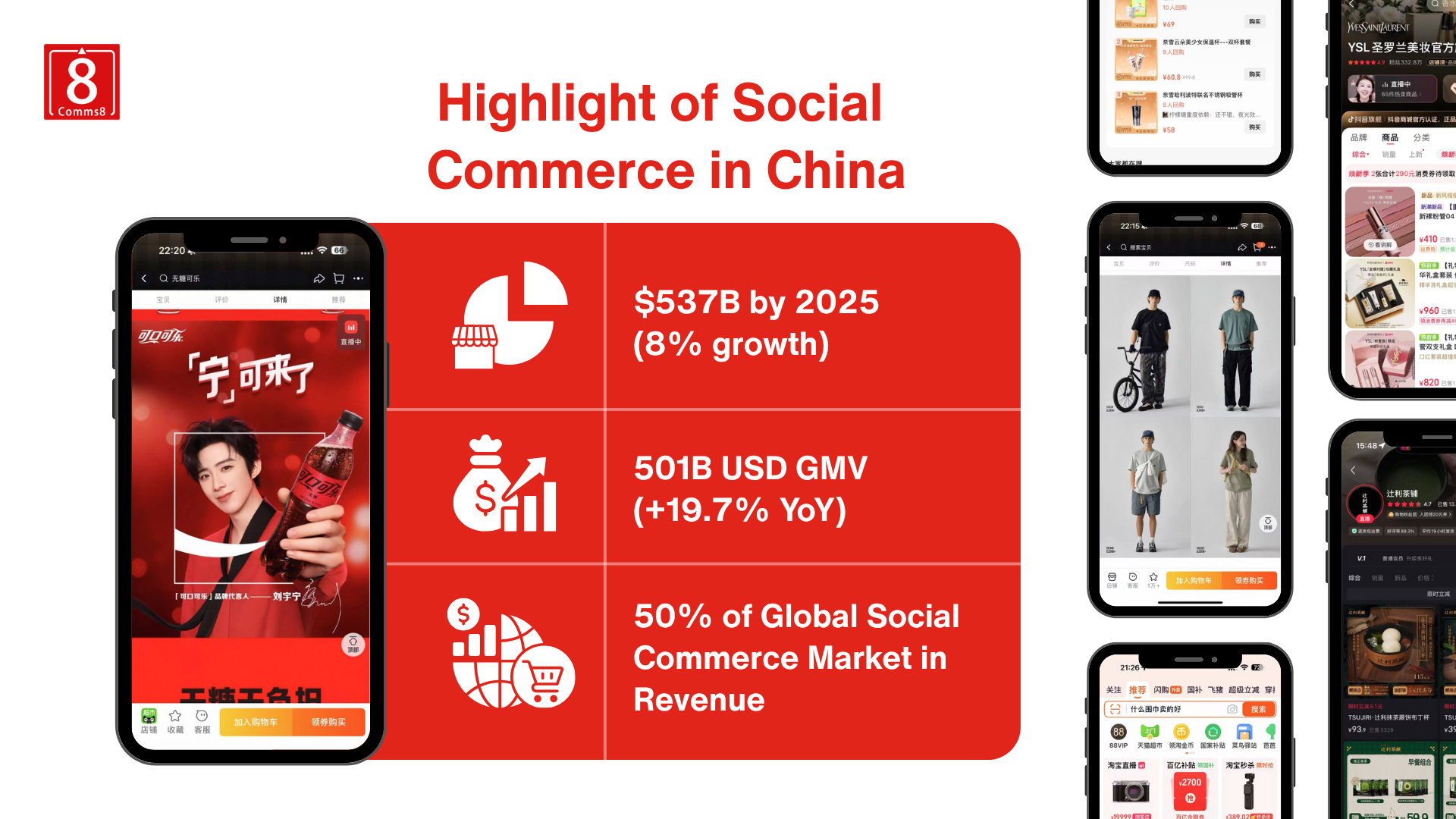
China’s social commerce continues its rapid growth trajectory by projected market to reach $4.22 trillion in 2026 (Research and Markets). A sign for China development in social media marketing.
At the same time:
Emarketer report livestream commerce is expected to surpass $1 trillion in value
Over 70% of consumers have purchased through livestream or social platforms
Social commerce already contributes 16%+ of total e-commerce sales (Marketing China)
This means that consumers no longer “search” for products, but by content.
From Content to Checkout: The Core of China Social Commerce Strategy
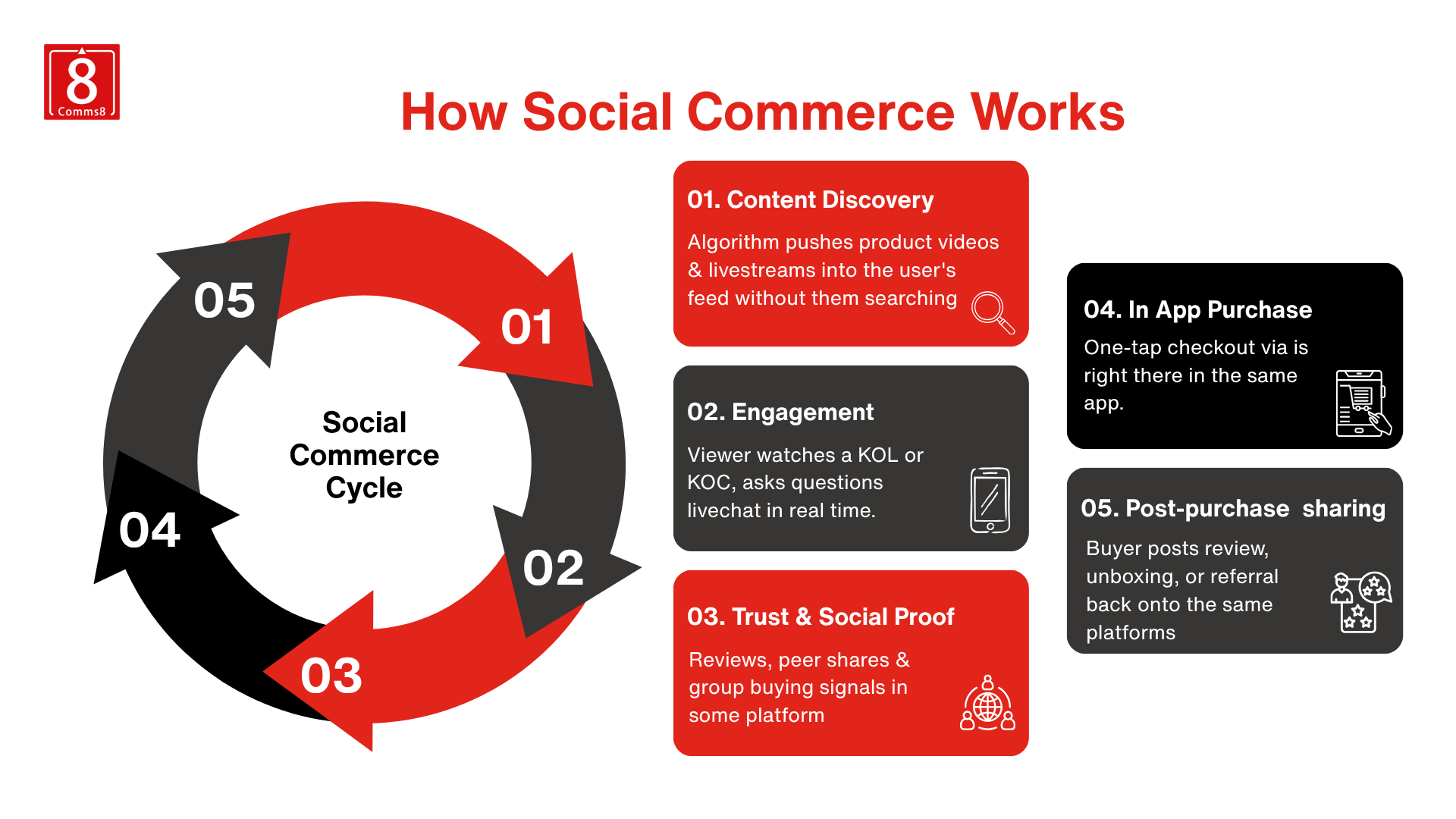
A successful China social commerce strategy in 2026 is built around content-first ecosystems, where:
Short videos drive awareness
Livestreams drive urgency
Integrated checkout drives instant conversion
Unlike Western with separated ecosystem, China’s model compresses everything into a single user journey. For brands, this means learning how to get discovered as an influencer is no longer optional, it’s a mandatory to revenue generation.
Key Shift: Interest-Based Commerce
Platforms like Douyin operate on interest-based algorithms, not follower graphs. This means:
Content quality is more important than follower count
Virality can happen instantly
New creators can scale fast
Live Commerce China: The Engine Behind Explosive Growth
Live commerce in China has evolved into the most powerful sales channel in the country.
Douyin alone contributes a massive share of live commerce GMV
Platforms integrate real-time interaction, limited-time deals, and influencer storytelling
Conversion rates far exceed traditional e-commerce
By 2023, China’s live commerce market had already reached $695 billion, with projections exceeding $1.1 trillion by 2026 (Trade.gov)
Why It Works
Live commerce China succeeds because it combines:
Entertainment (engaging hosts)
Social proof (real-time comments)
Urgency (flash discounts)
For creators, understanding how to get discovered as an influencer often starts with mastering livestream formats. By understanding everything about livestream, influencers could gain more engagement.
How Global Brands Are Winning in 2026
1. Content-Led Product Launches
Brands are not just launching products, they launch content narratives.
Example strategies:
Short drama storytelling on Douyin
Cultural campaigns tied to Chinese aesthetics
Influencer-led product seeding
This aligns directly with a strong China social commerce strategy. A content narrative attracting better than ordinary products
2. KOL and Influencer Ecosystems
Influencers (KOLs) are the backbone of commerce.
Brands are investing in:
Long-term creator partnerships
Micro-influencer networks
Livestream co-hosting
For creators, this reinforces the importance of understanding how to get discovered as an influencer across multiple platforms.
3. Seamless Content-to-Commerce Integration
China’s platforms eliminate friction:
In-video product links
One-click checkout
AI-driven recommendations
This “closed-loop commerce” is what makes the Douyin e-commerce brand guide so critical for success.
The Role of Content Localisation in Driving Sales
Global brands cannot simply replicate Western campaigns.
They must localise:
Messaging
Cultural references
Visual storytelling
Without localisation, even the best China social commerce strategy will fail to resonate.
Paid Media + Organic Content: A Unified Approach
Organic reach is powerful, but amplification makes it better.
Brands are combining:
Influencer content
Paid traffic boosting
Platform-native ads
This hybrid approach ensures visibility while scaling conversions.
How to Get Discovered as an Influencer in China
If you’re entering China as a creator or brand ambassador, here’s what matters:
1. Prioritise Content Quality Over Followers
Algorithms reward engagement, not size.Platforms reward content that generates interactions such as likes, comments, shares, and watch time.
This means that even creators with smaller audiences can go viral if their content resonates well. Instead of chasing followers, focus on:
Creating visually appealing and culturally relevant content
Hooking attention within the first few seconds
Encouraging interaction (questions, calls-to-action, storytelling)
High follower numbers don’t matter if your content isn’t being pushed by the algorithm.
2. Master Platform Formats
Each Chinese platform has its own strengths and content preferences, so adapting your format is key:
Short-form video: Best suited for Douyin, where fast-paced, entertaining, and trend-driven content performs well
Live streaming: Platforms like Taobao Live and Kuaishou are powerful for real-time engagement and direct selling
Lifestyle & aesthetic content: Ideal for Xiaohongshu, where authenticity and detailed reviews matter
Understanding not just the platform—but the format within each platform—is critical. Use formats and its platforms wisely
3. Be Consistent and Data-Driven
Consistency plays a major role in how algorithms rank your content. Posting regularly signals reliability and keeps your account active in the system.
At the same time, you need to track performance metrics such as:
Engagement rate
Watch time and completion rate
Conversion (especially for commerce content)
4. Collaborate with Brands Early
Unlike many Western markets, brand collaboration in China often happens earlier, even with smaller creators.
Working with brands can:
Boost your credibility
Increase exposure through brand-owned channels
Help you understand commercial content formats faster
Early partnerships also position you within the platform’s commerce ecosystem, which is a major growth driver in China.
5. Use Platform Tools Strategically
Chinese platforms offer built-in tools designed to amplify reach and drive conversions—especially in e-commerce.
For example:
In-app shops and product tagging
Livestream selling features
Algorithm boosting tools for high-performing content
Following structured platform guidelines (especially on Douyin’s e-commerce system) can significantly improve your discoverability.
The Future: AI, Instant Commerce, and Content Ecosystems
Looking ahead, China social commerce strategy will be shaped by:
AI-generated content (AIGC)
Virtual influencers
Instant checkout ecosystems
Search + social integration
Platforms are collapsing the gap between inspiration and purchase, making content the most valuable asset in digital commerce. But how about its ecosystem?
Conclusion
China’s social commerce ecosystem in 2026 has fundamentally redefined how brands drive sales: content is no longer a marketing tool, it is the entire sales journey. From discovery to conversion, everything happens within a single, seamless, content-driven environment.
For brands, success is no longer determined by traditional advertising or large follower bases, but by the ability to create engaging, localised, and platform-native content that converts instantly. Those who adapt to this “content-to-commerce” model will unlock massive growth opportunities, while those who rely on conventional strategies risk becoming irrelevant in China’s fast-evolving digital landscape
Key Takeaway from Brands
1. Content isn’t just marketing anymore, it is the sales channel
2. Short videos and livestreams are where real growth happens
3. Influencers aren’t optional, they’re essential
4. It’s not about how many followers you have, it’s about how good your content is
5. Make it easy for people to buy, instantly
6. Each platform has its own role, don’t treat them the same
7. Localisation goes beyond translation
8. Organic content and paid media should work in hand
For more in-depth insights, follow Comms8 where we help your brand expand into foreign markets.
At Comms8, we specialise in helping businesses leverage the power of cross-border marketing in Asia. With our expertise, we can assist you in harnessing the influence of social commerce strategies to boost your brand’s credibility and awareness. Contact us today to learn more about empowering your brand in the dynamic market.